

Fixed Income Briefing August 2026



Renée Friedman, Global Head of Research
US Economic and US Treasury Market Review
• The dollar has been weakening through August due to growing concerns around US debt levels hitting $40 trillion and the US Treasury’s actions to try to reverse the sudden surge in yields that has followed. As noted by Fitch Ratings, the feed-through from higher yields to actual funding costs is typically gradual, but high debt loads and a shifting investor base can make markets more sensitive to fiscal and monetary policy uncertainty, to the detriment of sovereign credit profiles. The dollar index is down by -0.67% MTD in August.
• On the labour market front, US economic data released in August suggest that the US economy is experiencing more weakness than previously indicated. The US Bureau for Labor Statistics showed that non-farm payroll jobs fell by 23,000 in July. In addition, the May and June figures were substantially revised downward, with a cumulative reduction of 103,000 jobs for those two months combined. Both the labour force participation rate, at 61.4%, and the employment-population ratio, at 58.9%, changed little in July. However, the labour force participation rate has fallen 0.7 percentage point since January and the employment-population ratio decreased by 0.5 percentage point. Employment declined in local government, education and retail trade, but continued to trend up in health care. The national unemployment rate came in at 4.1%, slightly lower than June’s 4.2%. Average hourly earnings were up 0.1% month-over-month and up 3.2% year-over-year in July 2026, slowing down from the previous month and marking the softest pace in almost five years. Additionally, the real (inflation-adjusted) average hourly earnings fell 0.2% over the 12-month period.
• On the wider growth front, business activity rose again in August, however the S&P Global Flash US PMIs were mixed. The Flash Composite PMI came in 56.0, up from July’s 54.5 and a 52-month high. Manufacturing came in slightly below expectations and services were materially stronger. The Flash Manufacturing PMI eased to 53.8, below consensus of 54.3 and down from June’s 53.9, hitting a 4-month low. The Flash Services PMI rose to 56.8, up from July’s 54.6 and a 20-month high. However, the Flash Manufacturing PMI fell to 53.2, down from July’s 53.9 and a 5-month low.
• On the consumer side, US consumer confidence fell in August to the lowest level since the start of the year on a deteriorating outlook for business conditions and the labour market. The Conference Board Consumer Confidence Index decreased by 0.8 points to 89.4, down from 90.2 in July. However, the Present Situation Index, based on consumers’ assessment of current business and labour market conditions, rose by 6.8 points to 121.2, following three months of consecutive decline. The Expectations Index, based on consumers’ short-term outlook for income, business, and labour market conditions, fell by 5.8 points to 68.2. As noted by Bloomberg news, the report suggested high gasoline prices and broader cost-of-living pressures alongside a slowdown in hiring continued to weigh on American households. This was reflected in the drop in US retail sales in July, which fell by 0.6% in July 2026, marking the first monthly decline in nine months. This negative consumer sentiment was also reflected in the preliminary August reading of the University of Michigan Consumer Sentiment Index which fell 7.6% in August 2026 to 51.0, down from July’s 55.2. This ended two consecutive months of improvement. While views of personal finances saw only minor declines, expected business conditions sank 11% for the short run and 17% for the long run.
• The headline personal consumption expenditures index (PCE) came in at 0.2% m/om and 3.7% on an annualised basis in July. The core PCE, which excludes food and energy items, advanced 0.2% from a month earlier and 3.3% from a year earlier, still well above the Fed’s 2% target Headline CPI in July fell to a seasonally adjusted 0.1%, bringing the annual inflation rate down to 3.4%% according to the Bureau for Labor Statistics. Core inflation came in at +0.2% m/o/m after being unchanged in June, while annualised core CPI was 2.5%, down from June’s 2.6%. The energy index decreased 1.5% in July, after plunging 5.7% in June. However, it still rose 14.7% over the past 12 months due largely to rising gasoline prices. Services costs, which are closely watched by Fed policymakers as an indicator of longer-run inflation trends, moderated significantly. Services costs saw modest increases, with services inflation, less energy, rising by 0.2% from the previous month and 3.0% over the 12-month period ending in July.
Yield swings
August has proven to be a very difficult month for bond markets with yield steepening continuing as real bond yields rose sharply around the world. Longer term bonds hit multi-decade high yields driven by rising debt levels, total and as a percentage of GDP, heavy sovereign borrowing, ongoing inflation concerns and uncertainties due to tariffs. As noted by the Financial Times, US public debt has risen from $3.4 tn in 2000 to $32.3 tn now, or a rise from 33.7% to more than 100% of GDP in just over 25 years. The rapid rise in debt and consequent rise in yields has also resulted in over 20% of government income being paid to service the debt payments. In the UK, concerns around rising energy prices and inflation expectations as well as continuing domestic fiscal uncertainty ahead of the autumn budget, has caused gilt yields to rise. Markets are still pricing in a September rate increase by the ECB, following its policy hold in July. Eurozone yields have risen more than in the US primarily due to the ongoing regional energy shock driving up inflation expectations and escalating concerns over European debt sustainability.
The US 10-year yield is -3 basis points (bps) from a month ago. The 10-year German Bund is +4.9 bps. The spread between the two is at 150 bps since the end of July. On the long-end of the curve, the US 30-year yield is +0.6 bps from a month ago, while the German 30-year yield is +8.9 bps from a month ago.
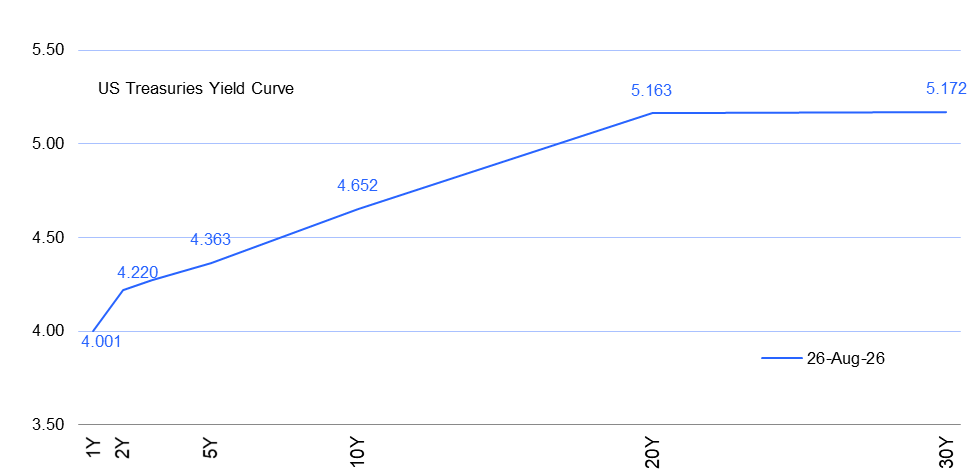
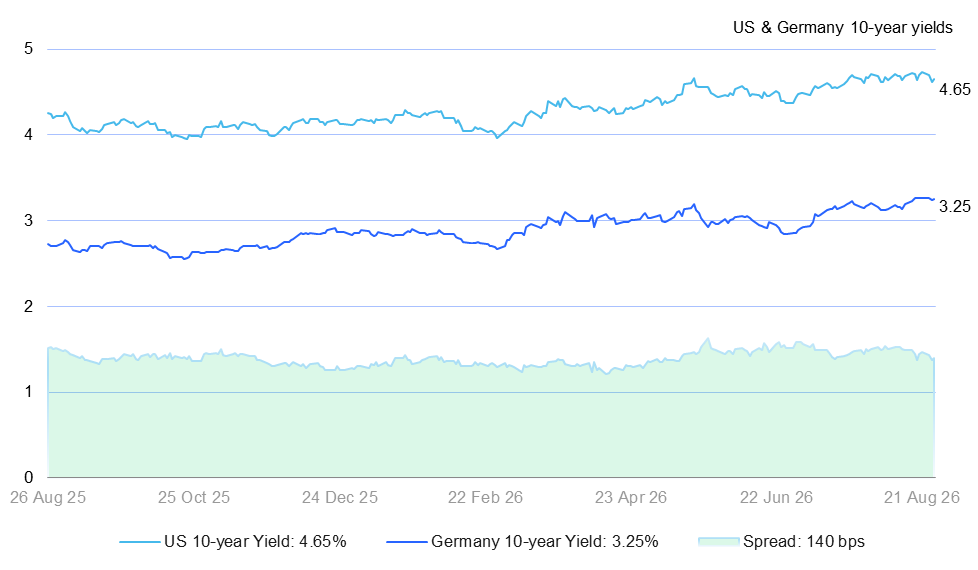
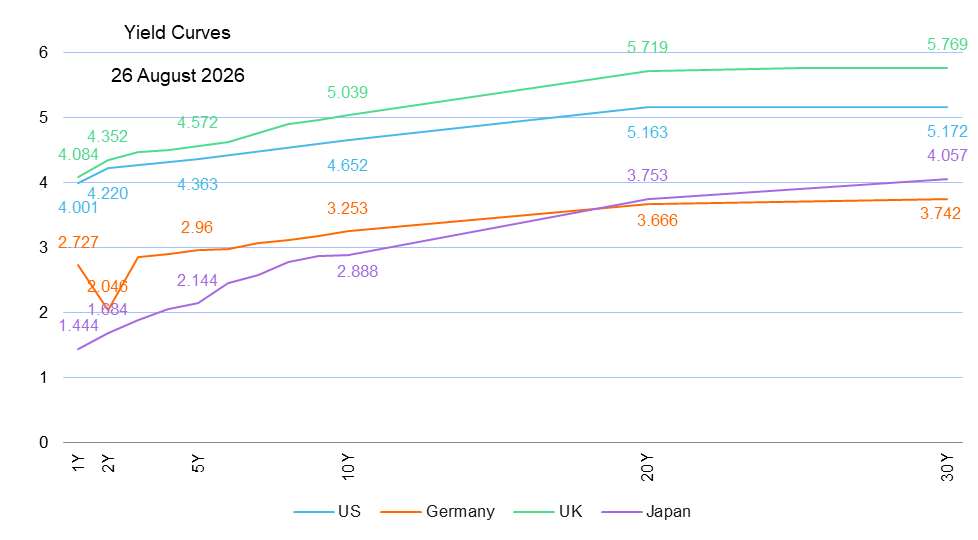
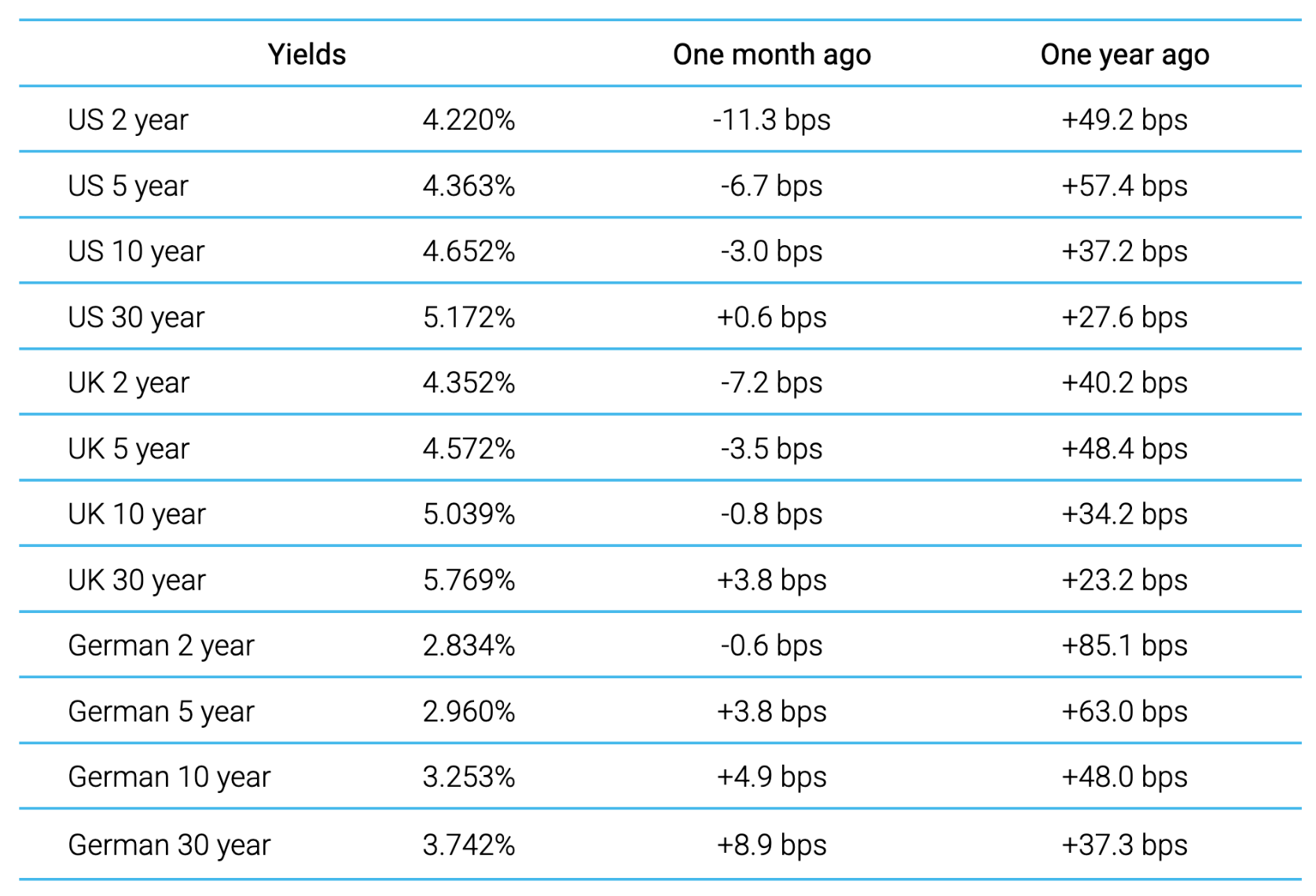
Source: Factset. FactSet 5:00 pm EST 26 August 2026
Global Economic and Market Review
The eurozone economy is holding on, but showing signs of stress from the war with Iran and the surge in energy prices. Eurozone headline inflation rose to 2.9% in July from June’s 2.8%. However, the ECB stated that in the latest consumer inflation expectations survey, consumer prices were seen rising 2.9% over the next year, down from 3% in June. The three-year gauge, considered more important for setting monetary policy, fell to 2.7% from 2.8% the previous month.
Eurozone activity rebounded more strongly than expected in August. The S&P Global Eurozone Flash Composite PMI rose to 52.1, edging up from July’s 52.0 and a 9-month high. Manufacturing output accelerated to a 52-month high of 53.0, while the headline manufacturing PMI rose to 52.0 from June’s 51.4. Germany was among the strongest contributors to the manufacturing recovery, with manufacturing production increasing at its fastest rate since January 2022. The Flash Eurozone Services PMI was unchanged from June’s 51.7. There was a further rise in new orders for the second month in a row amid a first expansion in new export business in four-and-a-half years. Firms also took on extra staff, led by service providers, while manufacturers reported a fractional increase in employment, the first in 38 consecutive months of job reductions in the manufacturing sector. Input price inflation slowed to its weakest rate since February while Output price inflation eased for a third successive month and reached its lowest level since March. Despite the improved picture during the month, business confidence softened and remained relatively muted.
European consumers are remaining relatively confident in the eurozone economy. According to the European Commission, the flash estimate of the consumer confidence indicator remained broadly stable in the euro area (+0.4 pps) compared to July. However, at -15.5 points, consumer confidence remains below its long-term average
Given the strength of the eurozone economy, ECB policymakers such as Executive Board member Isabel Schnabel, are suggesting that interest rates must rise further as the lengthy conflict in the Middle East and the unexpectedly strong eurozone economy pose upside risks to inflation. Markets are pricing in about 40 bps of tightening this year by the ECB, with the first rise expected in September.
In the UK, activity also improved, with the economy expanding at the fastest pace in four months. The Flash Composite PMI rose to 52.5 from July’s 52.2. Services also rose, coming in at 52.8, up from July’s 52.1 and a 6-month high, while manufacturing output hit a 5-month low, falling to 51.5 from July’s 51.9. Inflationary pressures intensified during August. Overall demand conditions improved again in August, as signalled by a further marginal rise in total new work received by UK private sector firms. The latest increase in new business was the fastest since February, driven by an acceleration in the service economy. However, the rate of input cost inflation at UK private sector firms accelerated for the first time in four months.
Headline inflation in the UK came in at 2.9% in the 12 months to July 2026, up from 2.6% in the 12 months to June according to the Office for National Statistics data. On a monthly basis, CPI rose by 0.3% in July 2026, compared with a rise of 0.1% in July 2025. The jump in inflation is largely due to a 13% rise in the price cap that sets household energy bills. It was only partly offset by cheaper motor fuel and downward pressure from air fares. Core inflation rose by 2.6% in the 12 months to July 2026, unchanged from the 12 months to June. The CPI goods annual rate rose from 1.7% to 2.2%, while the CPI services annual rate eased from 3.6% to 3.4%.
According to the Office for National Statistics (ONS) August 2026 release, the unemployment rate is 4.9% in April to June 2026. This is up by 0.2 percentage points on the year but down by 0.1 percentage points on the latest quarter. The economic inactivity rate was estimated at 20.9% in April to June 2026. This is largely unchanged on both the year and on the latest quarter. The early estimate of payrolled employees for July 2026 decreased by 94,000 (0.3%) on the year, but was largely unchanged on the month, decreasing by 13,000 (0.0%) to 30.3 million. The estimated number of vacancies in the UK decreased in the latest quarter. Early estimates for May to July 2026 suggest a decrease of 6,000 (0.8%) to 707,000, compared with February to April 2026.The labour market is becoming increasingly fragile with job vacancies falling on the quarter, with early estimates for May to July 2026 suggesting a decrease of 6,000 (0.8%) vacancies to 707,000, compared with February to April 2026. Annual growth in employees' average earnings in Great Britain was 3.5% for regular earnings (excluding bonuses) and 4.1% for total earnings (including bonuses) in April to June 2026.
Things to think about
Markets are still pricing in interest rates rises in Europe this year with a possibility of rise in the UK as investors consider ongoing and future geopolitical disruptions. Additionally, the increasing issuance of corporate bonds by hyperscalers to help fund the AI build out is affecting both duration and term premia as it threatens to crowd out some sovereign issuance. The competition for capital will remain strong as governments in the US, UK, Europe and Japan will need to continue issuing debt to finance persistent deficits and, in the case of the US, to cover the suggested 50% increase in defence expenditures.
In the US, Fed Chair Kevin Warsh’s speech at the Fed’s annual Jackson Hole symposium this weekend will be very closely watched. Warsh’s decision to move away from the forward guidance provided by his predecessor has contributed to bond market volatility. The Treasury department's attempts to push down rates at the long end by doubling buy backs signalled discomfort with elevated long-end yields and an unofficial acknowledgment that there may be something to those concerns about debt sustainability. It also appears to have potentially put the Treasury department at odds with the Fed over appropriate market signals for the bond market. Fed policymakers will likely need to put out more hawkish messaging if it hopes that the market will continue to tighten bond yields without it having to take direct action.
Yields are expected to remain higher for longer, driven by continuing geopolitical risks, energy-sector cost pressures and cautious central bank stances. The Bank of England will remain data-dependent, but with energy bills forecast to go up again in October, piling further cost of living pressures on households, there will be increasing pressure on the MPC. In addition, uncertainties around the potential introduction of new property and other taxes by Prime Minister, Andy Burnham, may have an impact on consumer confidence and economic growth moving forward into Q4 and beyond.
Risk premiums will continue to be driven by persistent inflation and heavy capital spending pressures. Geopolitical uncertainty is still high; there is still a chance that there could be an escalation in the war with Iran and/or that it could be drawn out even further, causing the market to price a more aggressive Fed next year. Investors may wish to consider selective yield-spread targeting, continuing to diversify across geographies to reduce country-specific risks. This may look a particularly attractive choice as EM bonds have outperformed due to dollar weakness. This dollar weakness may continue if Treasury Secretary Bessent makes further attempts to control bond pricing and/or Fed chair Warsh signals a dovish shift in policy expectations. However, with central banks generally adopting a more hawkish tone and yield steepening likely to continue, short-duration paper remains attractive as real yields rise. Investors may also wish to use inflation-protected securities (e.g., TIPS) to hedge inflation risk.
Key risks
• Inflation risks continue to rise, further undermining consumer and business confidence. Despite expectations that the war with Iran would be over by this point, the inability of the US and Iran to agree a permanent ceasefire and terms on the passage of ships through the Strait of Hormuz means that oil prices could jump further. The re-introduction of tariffs by the Trump administration further complicates the growth outlook and potentially adds to inflationary pressures. Although the US economy is still strong and faster growth would help with increasing tax revenues that have slowed under President Trump’s cuts as well as reduce debt sustainability concerns, such growth would also put pressure on the FOMC to raise rates, potentially compounding the yield surge risks we are already seeing.
• Policy uncertainty. The central banks may get the timing of rate hikes wrong or we may see a faster divergence in policy due to fragile geopolitical energy dynamics. Although the case for a September rate hike for the US remains strong, softer inflation data lessens the likelihood of it being delivered. However, a bigger risk is the volatility created by less guidance from the US Fed. This is showing up in the front end in particular. Fiscal stimulus changes amid domestic political pressures, especially those expected to emerge in the UK under the Burnham government, may create additional volatility in gilt markets. A rise in yields pushes up interest rates across the economy, raising borrowing costs for consumers and the government alike. This may affect consumer demand and wider growth prospects in the UK.
• Geopolitical tensions, re-alignments and events. Retaliatory measures by Canada in response to tariffs and by Iranian allies such as China in response to increasing US sanctions against Iran, may influence a shift in safe-haven demand and risk premiums. Geopolitical risk stemming from the Iran war, increasing uncertainty around the US mid-term elections, the threat to Taiwan from mainland China, the increasingly aggressive behaviour by the Chinese navy in the South China Seas, the potential continuation of US military and political activities in Latin America and the ongoing war in Ukraine, all have the potential to hit supply chains and shock economies with the consequent effects on inflation, bond yields and currency valuations.
هذه المقالة متاحة لأغراض معلوماتية فقط، ولا ينبغي اعتبارها عرضًا أو التماسًا لعرض شراء أو بيع أي استثمارات أو خدمات ذات صلة يمكن الإشارة إليها هنا. ينطوي التداول في الأدوات المالية على مخاطر كبيرة من الخسارة وقد لا يكون مناسبًا لجميع المستثمرين. الأداء السابق ليس مؤشرًا موثوقًا به للأداء المستقبلي.








أنشأها المتخصصون. للمحترفين.
