

Fixed Income Briefing October 2026



Renée Friedman, Global Head of Research
Key takeaways
- The dollar reached 18 months highs in October due to a more hawkish Federal Reserve policy outlook and robust economic indicators. The dollar index is +1.08 % MTD in October.
- Yields have continued to come under pressure as a highly capital-intensive AI boom is weighing on credit spreads along with increasing fiscal concerns in the US, in key European markets and in Japan, with risk premia rising. Among developed markets, the sharpest increases have hit those countries with the weakest public finances, including France (+132.5 bps YTD), Italy (+102 bps YTD), the US (+102.1bps YTD), Japan (+92.7bps YTD), and the UK (+94.5bps YTD). As noted by the IMF, the interaction of higher financing costs with elevated debt levels exposes a vulnerability. The buffer to absorb shocks may no longer be there.
- Major risks include the lingering energy shock and impact on inflation feeding through to expectations and driving up wage demands. The rise in core inflation in the US suggests that price pressures are becoming more entrenched. This may force further Fed tightening alongside the ECB’s expected moves, with the BoE increasingly looking likely to have to follow suit.
Below we review the economic data and bond market performance of the US, Europe, and the UK. We offer facts and ideas for investors to think about and consider the key risks that exist for fixed income investors.
US Economic and Treasury Market Review
- On the labour market front, data released in October suggests that the US economy is experiencing more weakness than previously indicated. The US Bureau for Labor Statistics showed that non-farm payroll jobs increased by only 29,000 jobs in September, far below expectations of 90,000, while revisions removed another 60,000 jobs from July and August. That lowered the three-month average to 51,000. The labour force participation rate edged up from August’s 61.6 % to 61.8 %. The national unemployment rate edged up to 4.2 % from August’s 4.1 % and the number of unemployed people climbed slightly, reaching 7.1 million, up from August’s 7.0 million. Household employment actually rose, making this something short of an unambiguous recession signal. More consequential was the 0.1 % monthly increase in average hourly earnings, down from August’s 0.3 % and up 3.0 % year-over-year, also down from August’s 3.1 % rate.
- On the economic growth front, business activity growth accelerated for a fourth successive month in September. The Final Composite PMI came in at 58.4, up from August’s 56.0 reading and a 62-month high. The Final Manufacturing PMI surged higher in September, posting 55.9, up from 53.9 in August on domestic orders as new export orders fell for the fifteenth successive month due to tariffs and elevated shipping costs dampening international sales. The Final Services PMI rose to 58.7 from August’s 56.5 and a 59-month high. Business confidence also strengthened and was at a one-year high, while companies responded to rising workloads by ramping up hiring activity.
- On the consumer side, US consumer sentiment was down again in October. The University of Michigan Consumer Sentiment Index fell by 3.7 % to 46.3, down from September’s 47.8. The Current Economic Situation survey plunged 12.2 %, from September’s 50.9 to 44.7, while the Index of Consumer Expectations rose 2.2 % to 47.3 from September’s 45.8. Consumers expect prices to rise 4.7 % over the next 12 months, up slightly from September’s 4.6 % year ahead view. They also saw costs rising at an annual rate of 3.5 % over the next five to 10 years. Long-run inflation expectations also stepped up from 3.4 % in September to 3.5 %, notably higher than their 2024 range of 2.8 % to 3.2 %.
- On the inflation front, headline CPI in September rose to a seasonally adjusted 0.6 % on a seasonally adjusted basis in August after rising 0.4 % in August. The annual inflation rate jumped to 3.7 % from August’s 3.4 % according to the Bureau for Labor Statistics. Core inflation came in unchanged from August’s +0.3 % m/o/m, while annualised core CPI was 2.6 %, up from August’s 2.4 %. The energy index increased 5.2 % in September after rising 2.1 % in August. The index for gasoline soared to 9.1 % in September from August’s 3.9 %. Services costs, which are closely watched by Fed policymakers as an indicator of longer-run inflation trends, saw a slight increase, with services inflation, less energy, edged up to 0.4 % from the previous month’s 0.3 % and came in at 3.1 % over the 12-month period ending in September, up from August’s 3.0 % annualised rate.
Yield swings
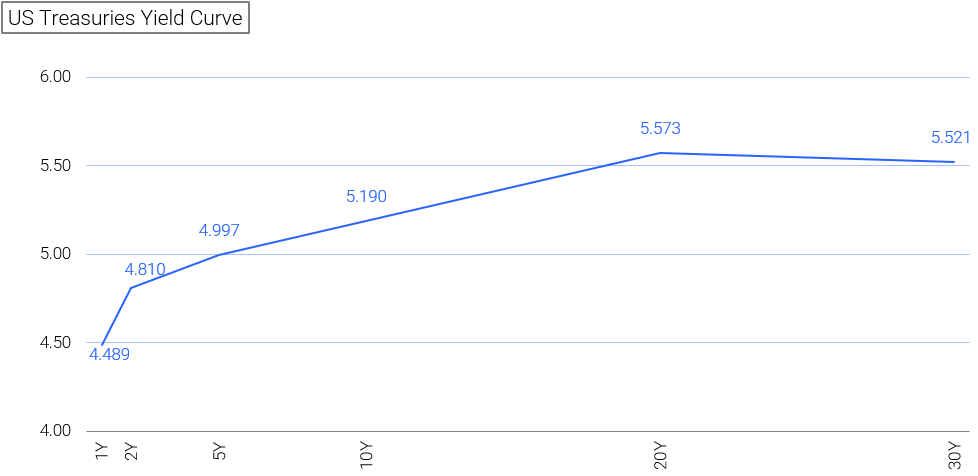
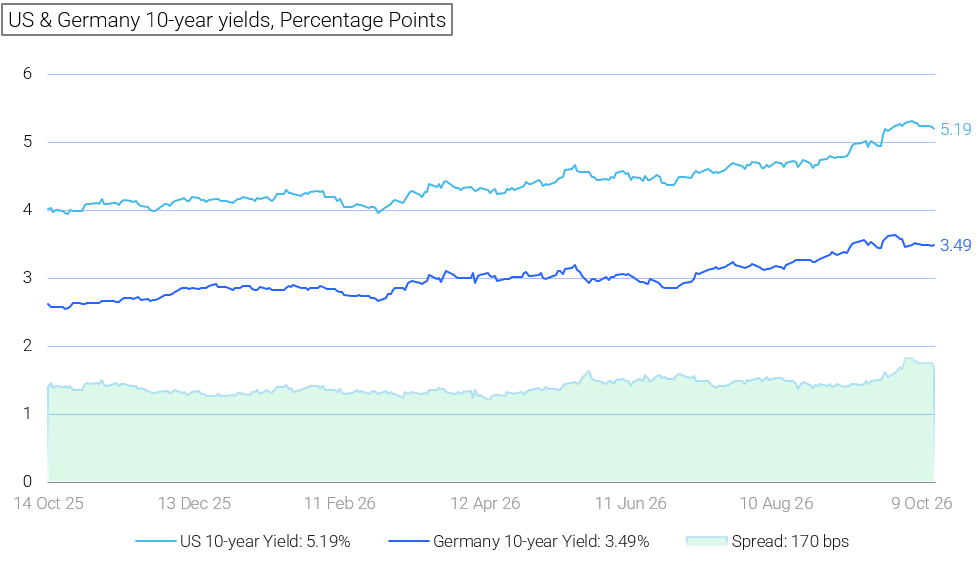
Thus far October has seen bond markets mixed but resilient. Although benchmark 10-year US Treasuries saw yield surge to their highest level since 2002 before retreating after strong bond auctions. European bonds have also sold off, but the primary focus this month has been on French bond markets, which have come under extreme pressure in the face of rising fiscal deficits and domestic policy uncertainty in the run up to next year’s election
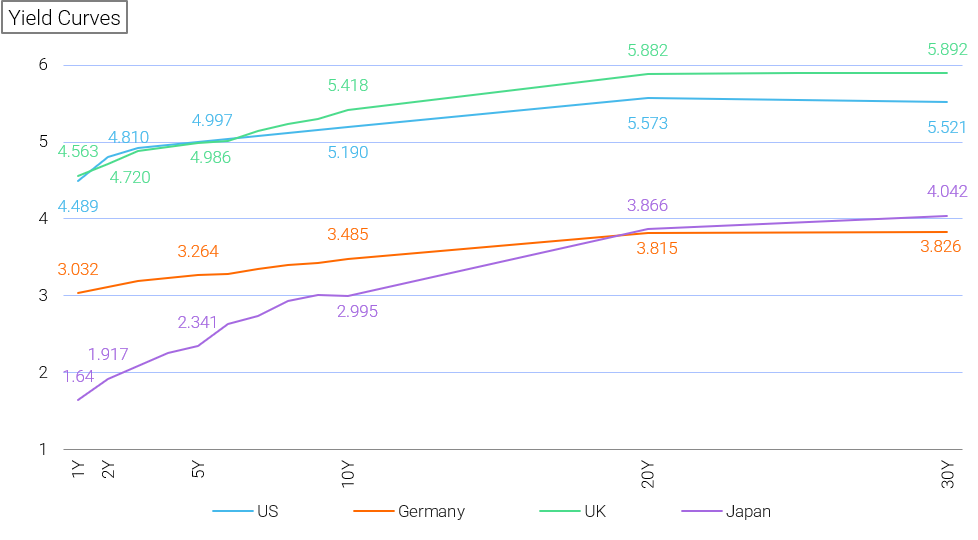
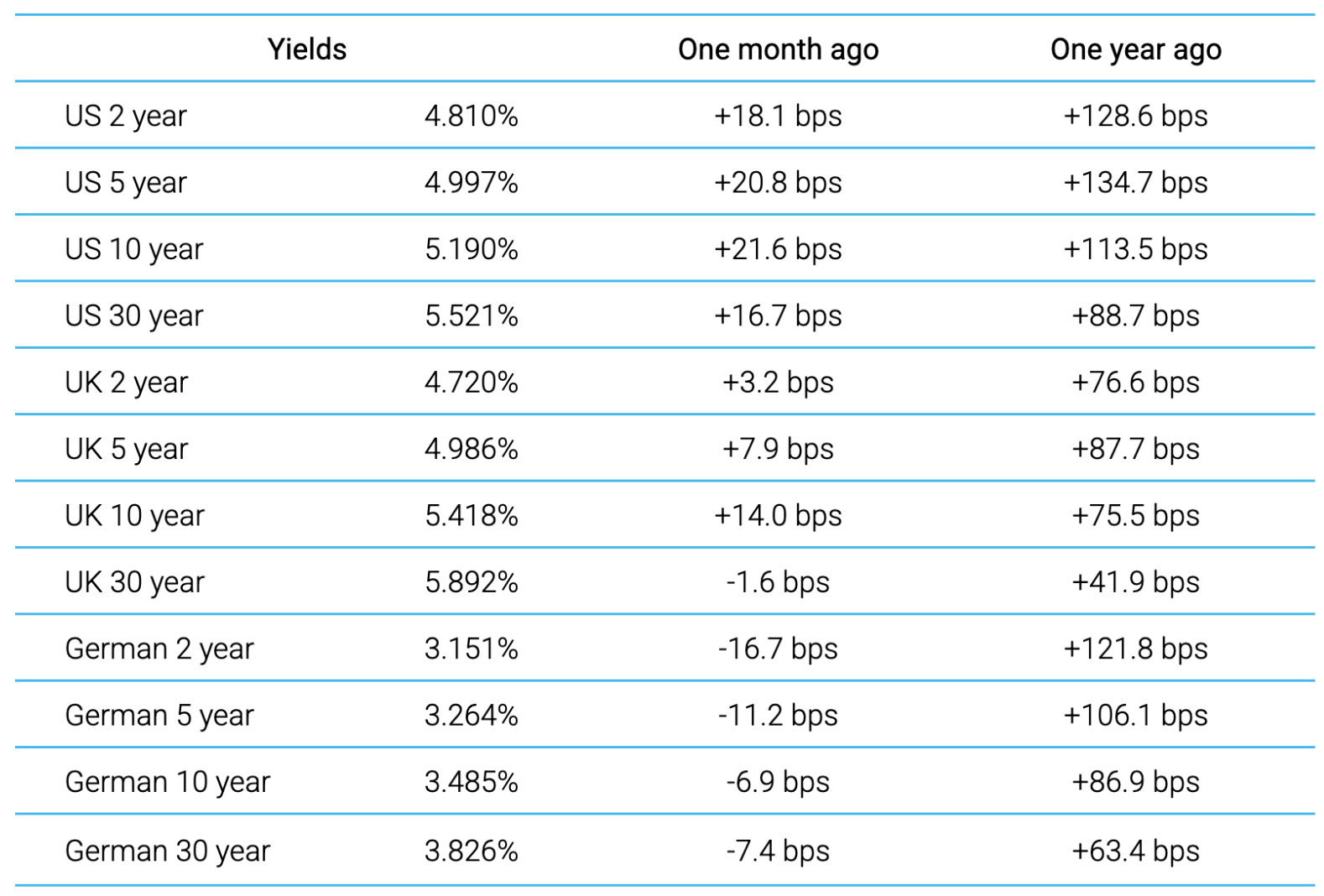
The US 10-year yield is +21.6 basis points (bps) from a month ago, but -8.5 bps MTD. The 10-year German Bund is -6.9 bps from a month ago and -9.8 bps MTD. The spread between the two has risen to 170 bps, just slightly up from the end of September’s 169 bps. On the long-end of the curve, the US 30-year yield is +16.7 bps from a month ago and -10.2 bps MTD, while the German 30-year yield is -7.4 bps from a month ago and -9.4 bps MTD.
Source: FactSet
Source: FactSet
Source: FactSet
Global Economic and Market Review
Eurozone
The eurozone economy is faring better than expected, but still showing signs of stress from the war with Iran and the surge in energy prices. In its October forecast, the IMF has said that economic growth in the eurozone will slow to 1.1 % this year before slightly accelerating to 1.2 % in 2027. It attributed this to persistently high energy costs and weak consumer confidence. The IMF noted that "gas inventories remain below seasonal norms in parts of Europe, leaving gas market conditions vulnerable to adverse weather ahead of the winter heating season".
However, eurozone business activity was surprisingly resilient in Q3, despite the increase in energy prices emanating from the ongoing conflict in the Middle East. The Final S&P Global Composite PMI for September came in at 53.1, up from August’s 52.0,.a 41-month high, while the Final Services PMI came in at 53, up from August’s 51.6. The Final Eurozone Manufacturing PMI came in at 52.9, up from August’s 52.7 and a 52-month high. Price pressures intensified, with rates of inflation for input costs and output prices accelerating for the first time since May. However, for the first time in more than four years, all eight of the euro area countries covered by the survey posted an expansionary Manufacturing PMI reading in September.
The IMF has forecast inflation at 3.1 % this year and 2.8 % next year, significantly above the European Central Bank's target of 2 %. The September print of 3.8 % y/y should increase the probability of a Q4 tightening, given the eurozone’s high energy import shares, and relatively low stock levels. Yet, only 14 % of traders are expecting a 25-bps rate hike in the October meeting to 2.75 %, while 76.6 % are expecting a hike to 3.00 % at the December meeting according to ECB Watch.
United Kingdom
In the UK GDP unexpectedly increased by 0.1 % in August, above the 0.1 % contraction expected by economists, following 0.4 % growth in July, according to the Office for National Statistics. It was the fourth straight month growth has beaten the consensus prediction. On a three-month basis, output was up 0.7 %. The IMF has forecast that the UK economy would expand by 1.3 % in 2026, up from the 1 % it predicted in July, before slowing to 1.2 % in 2027.
The Final S&P Global Composite PMI for September came in at 52.0, revised slightly higher from the preliminary estimate of 51.7, though down from August’s 52.5. The Final S&P Global Services PMI came in at 52.1 in September, down from 52.5 in August but signalling a moderate overall expansion of output levels. September data marked two years of continuous job cuts across the service sector as a whole. However, the rate of decline in workforce numbers remained only modest and was the slowest since October 2025. However, new business growth slowed in September and was only marginal overall. Backlogs of work decreased. Rates of input cost and output price inflation recorded by private sector firms reached the highest since June, largely due to higher energy, fuel and transport bills. The Final S&P Global Manufacturing PMI came in at 51.9 in September, up from 51.7 in August. The PMI has signalled expansion in each of the past 11 months. Companies continued to scale up output in response to rising new order intakes, with new work growing from both domestic and export market,
The government’s business insights and conditions survey showed that nearly three-quarters (72 %) of businesses reported some degree of concern about energy prices in late September 2026. It also indicated that nearly three-quarters (73 %) of businesses reported some degree of concern about increases in fuel prices. This is important for future business investment as headline inflation in the UK is forecast to rise in Q4, with the Bank of England suggesting it could reach 3.7 %, well above the BoE’s 2 % target.
Things to think about
We will remain in a high yield environment, largely due to yields being driven mainly by higher real interest rates rather than sudden shifts in inflation expectations or term premium. Credit spreads appear to be stabilising after widening earlier in October, and primary issuance has been relatively light. The rise in real rates we are seeing is happening due to increasing competition for capital pushing up the neutral rate while the ongoing war with Iran and higher oil prices have continued to worry traders and central bankers in terms of second round effects. There are also ongoing (Ukraine/Russia and Iran) and future geopolitical disruptions (elections in the various eurozone countries, the unresolved situation between China, Taiwan and the US) as well as an expected rise in food price inflation due to rising energy and commodity input costs, record-breaking summer droughts, heatwaves and poor harvests and the ongoing conflicts in Ukraine and Iran continuing to pose risks to agricultural supply chains.
In the US, expectations of a Fed rate rise for the October meeting remain under 25 % despite the surprise increase in September’s CPI. The US economy is bifurcated, with strength coming from upper-income consumers and AI-exposed sectors .US households are becoming increasingly frustrated with worsening affordability problems as price increases are outpacing wage growth with average hourly earnings, adjusted for inflation, falling consecutively for the past six months. However, as long as oil prices remain above $100 per barrel, it will be difficult for the Fed to extend its still expected October pause. There are increasing expectations of rate rises in December and possibly beyond. However, markets will be watching closely to the rhetoric around budgets and fiscal policy in the run up to the midterm elections as rising debt levels and debt sustainability remain a concern.
In the eurozone, energy costs are keeping inflation elevated, while borrowing costs are rising. Markets are pricing in at least one interest rate rise in Europe this year as investors consider the contractionary pull on eurozone growth from the energy shock and the expansionary pull from the AI CapEX boom. The ECB will likely be looking for solid evidence of second‑round effects from the rise in energy costs in addition to being vigilant around the emerging sovereign risks that came to the fore earlier this month. Although the ECB could use the Transmission Protection Instrument it created in 2022, it is looking increasingly unlikely as this would essentially mean the end of rate-based tightening. There is significant budget uncertainty in France and Italy will see increasing political pressure to spend with the 2027 election approaching and the far right gaining ground in the polls.
In the UK, the Bank of England has taken a wait-and-see approach to whether the price shock caused by the war with Iran feeds through to wider price and wage setting in the economy. There will be increasing pressure on the MPC to act, although BoE Chief Economist Huw Pill has questioned whether the BoE needs to match trader bets of a full 100-basis-point (four-hike) increase that would push rates from 3.75 % to 4.75 %. Markets are still jittery about the autumn budget statement, which may have a negative impact on consumer confidence and economic growth in the quarters ahead.
Geopolitical uncertainty is still high; with the US appearing to splinter from its support of Ukraine over its bombardment of Russian energy infrastructure. There is still a chance that there could be an escalation in the war with Iran, causing the market to price a more aggressive Fed next year. Investors may still wish to focus on selective yield-spread targeting, continuing to diversify across geographies to reduce country-specific risks. Emerging markets have continued to lead on both a total and excess return basis. However, with central banks generally adopting a more hawkish tone, short-duration paper, in the 2-to-5-year range, remains attractive relative to longer duration bonds which are more exposed to fiscal policy risks, higher debt levels and political uncertainty. Given that market implied inflation expectations have remained subdued in the US, investors may also wish to use inflation-protected securities (e.g., TIPS) which also offer higher yields.
Key risks
- Inflation risks continue to rise, further undermining consumer and business confidence. The ongoing war with Iran, despite the increasing number of ships passing through the Strait of Hormuz means that oil prices could jump even higher if energy infrastructure continues to be attacked both in the Gulf region and in Russia. This would require faster action by central banks.
- Policy uncertainty. The timing of rate hikes may be too late or we may see a faster divergence in policy due to increasingly fragile geopolitical energy dynamics. In Europe, we are likely to see growing national and wider regional friction, with the far-right RN party likely to win in France’s election next year and increasing uncertainty around Italy’s elections. Germany is also suffering following on from its regional elections as the coalition government faces an acute survival crisis. All of this may influence regional and EU wide fiscal policies. In addition, the Fed may ultimately deliver less tightening than the ECB or the Bank of Japan, creating potentially important divergence across rates and FX. Fiscal stimulus changes amid domestic political pressures may create additional volatility in gilt markets. UK nominal and real yields are now at multi-year highs and there is, as noted by LSEG research, a higher longer-term premium for UK inflation.
- Geopolitical tensions, re-alignments and events. Geopolitical risk stemming from the Iran war, increasing uncertainty around the US midterm elections and the likely policy gridlock that will result, the threat to Taiwan from mainland China and the ongoing war in Ukraine, all have the potential to hit supply chains further, with the consequent effects on inflation, bond yields and currency valuations. As noted by the IMF, without shoring up supply capacity and replenishing policy buffers, the global economy could soon test the limits of resilience. Dwindling energy inventories could allow geopolitical shocks to transmit even more forcefully to energy prices.
هذه المقالة متاحة لأغراض معلوماتية فقط، ولا ينبغي اعتبارها عرضًا أو التماسًا لعرض شراء أو بيع أي استثمارات أو خدمات ذات صلة يمكن الإشارة إليها هنا. ينطوي التداول في الأدوات المالية على مخاطر كبيرة من الخسارة وقد لا يكون مناسبًا لجميع المستثمرين. الأداء السابق ليس مؤشرًا موثوقًا به للأداء المستقبلي.
 العودة إلى جميع الرؤى







أنشأها المتخصصون. للمحترفين.
