

Higher for longer, but why?

 S&P 500 -0.02% to 7,805.45 US 10-year yield -1.4 basis points to 5.223% Spot gold -0.21% to $4,161.00 an ounce DXY -0.34% to 102.21
What to look out for today
Companies reporting on Wednesday, 14th October: Bank of America, BlackRock, Morgan Stanley, State Street Corporation, ASML, Fastenal
Key data to move markets today
EU: Spanish Harmonised Index of Consumer Prices and speeches by ECB President Christine Lagarde, Executive Board members Isabel Schnabel and Frank Elderson, and Banco de España Governor José Luis Escrivá
UK: A speech by BoE Chief Economist Huw Pill
USA: Consumer Price Index (CPI), Core CPI, Monthly Budget Statement, Fed’s Beige Book and a speech by Fed Governor Michelle Bowman
JAPAN: A speech by BoJ Policy Board Member Junko Koeda
GLOBAL: IMF/World Bank autumn meeting
Global Macro Updates
CPI, GPUs and crude meet the Fed’s conditional patience. Today’s CPI report will test if the price pressures confronting the Fed remain contained or are beginning to spread across the economy. For New York President John Williams, as stated in an interview with Bloomberg news, the baseline remains one further rate increase this year and no need, at present, to extend tightening into 2027. That view rests on an expectation that inflation resumes its descent as underlying cost pressures moderate and activity settles closer to potential. A more hawkish policy path would require more than a headline inflation increase driven by energy. It would require clear evidence that price pressures are becoming broader, more persistent and more widely transmitted across the economy.
The oil price shock from the war with Iran presents the clearest risk of such transmission. Higher crude prices, refinery disruptions and rising transport costs may initially appear to be relative price adjustments. The greater concern is that these pressures spread beyond petrol stations to freight, aviation, food, logistics and everyday goods and services. If companies raise prices broadly to restore margins, or workers seek higher wages to offset weaker real incomes, policymakers would face broader second round inflation rather than just an oil shock. That would be the clearest route from ‘one more’ hike to an open-ended tightening bias.
Fed Governor Christopher Waller’s intervention at Bloomberg’s New Economy Forum offers a useful counterweight. His point is that while higher long-end yields do not absolve the Fed of responsibility, they are already delivering some restraint where monetary transmission is most visible. Housing, autos and other duration-sensitive activities should feel the effect as financing costs rise. Yet Fed Governor Waller draws a careful distinction. Higher real yields driven by stronger growth and productive investment are far healthier than those caused by inflation concerns or fiscal anxiety. The distinction matters because the latter would imply that financial conditions are tightening for the wrong reason and might compel the Fed to do more.
AI muddies that distinction. Waller outlines a two stage process in which vast hyperscaler investment, largely insensitive to price, initially increases demand for chips, data centre capacity and related inputs. Productivity gains may expand supply and lower unit costs only later. In the meantime, the build-out can sustain demand, keep real yields elevated and make the economy less interest-rate-sensitive than conventional models assume. Waller believes those demand pressures could persist for two to three years, given committed spending plans, even if they remain concentrated rather than economy-wide.
That’s why the practical hierarchy is becoming clearer. The Fed can tolerate energy and AI-related price pressure if it stays narrow, temporary and unaccompanied by rising inflation expectations or wages. It becomes less tolerant if supply-chain disruption broadens cost pass-through, or if AI capex shifts from a sectoral boom into a durable source of economy-wide demand. An in-line CPI would preserve conditional patience. A broad upside surprise, particularly across core services, wages or inflation expectations, would make higher yields a complement to further Fed restraint instead of a substitute for it.
US Stock Indices
Dow Jones Industrial Average +0.38%
Nasdaq 100 -0.31%
S&P 500 -0.02%, with 6 of the 11 sectors of the S&P 500 down
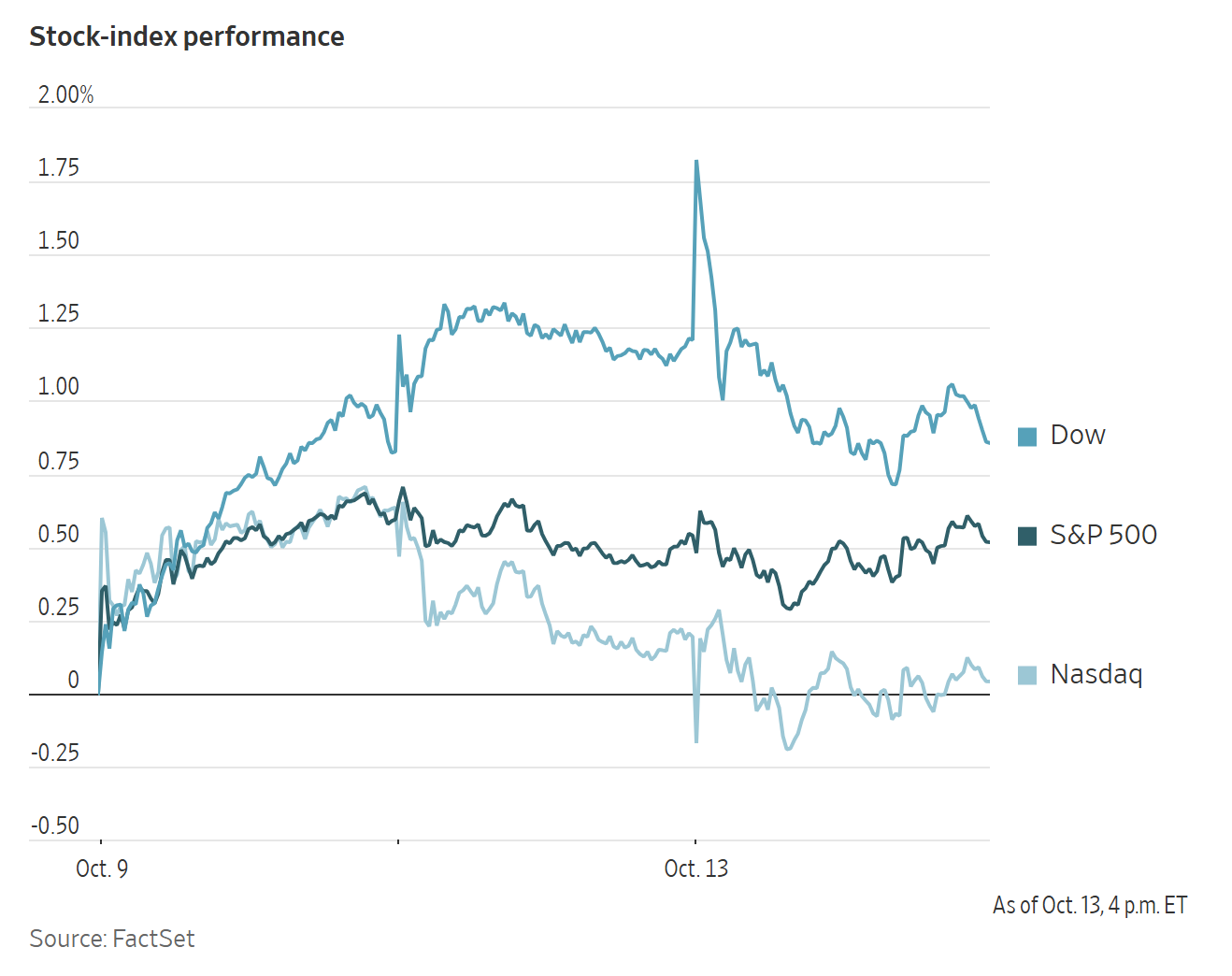
US equities struggled to gain momentum on Tuesday despite a solid start to the Wall Street earnings season.
Banks opened the Q3 earnings season with divergent results, as outlined in the preview included in the latest edition of our weekly Earnings Scoreboard, “The Quality of the Beat.” Strong results from Goldman Sachs and Citigroup contrasted with top- and bottom-line misses at JPMorgan Chase and weaker revenue at Wells Fargo. Nevertheless, guidance was broadly constructive, including favourable revisions to net interest income, particularly at JPMorgan Chase, lending margins at Citigroup and expense trajectories at both institutions.
Equity trading was a notable strength for Goldman Sachs and JPMorgan Chase, helping offset widespread softness in fixed-income, currencies and commodities (FICC). Consumer health remained resilient across credit metrics and card spending, although chief financial officers highlighted cautious borrowing among middle-market companies facing persistent input-cost inflation.
Financing for AI infrastructure also emerged as a key strategic theme. Goldman Sachs and Citigroup reported stronger activity in public and private debt issuance by technology companies, while Wells Fargo and JPMorgan Chase noted institutional risk limits related to power constraints and the potential crowding out of capital.
Four of the Big Six set the tone for a subdued equity session. The Dow Jones Industrial Average outperformed, rising +0.38%, or 195.70 points, while the S&P 500 slipped -0.02%. The Nasdaq Composite lagged, declining -0.15% to close at 27,204.38.
Technology stocks also traded on uncertain footing after comments from CXMT, one of China’s largest memory-chip manufacturers, heightened concerns about intensifying Chinese competition.
Over the next 48 hours, investors will look to ASML and TSMC to restore confidence in the sector. ASML’s capacity expansion guidance has become an important signal of its earnings reports, with investors focussed on the company’s ability to meet demand for its photolithography systems.
In corporate news, BP announced that it will update its strategy in December, giving Chief Executive Meg O’Neill her first opportunity to present her vision to investors. The company expects Q3 net debt of between $13.5 billion and $14.5 billion, down from $22.3 billion in Q2. BP also indicated that it would record a charge of $3 billion to $4.5 billion against its transition businesses, including electric vehicle charging.
Visa received approval to begin preparations to establish a domestic bank card clearing institution in China. Chief Executive Ryan McInerney said the decision allows the company to initiate formal preparations for domestic operations. The approval followed meetings between US President Trump and Chinese leader Xi Jinping in Beijing and Washington.
Stellantis estimated that Q3 global vehicle shipments declined 1% to 1.29 million. North American shipments fell 12%, primarily because of planned production downtime that largely affected Jeep models. By contrast, European shipments rose 10%, supported by the company’s joint venture with Chinese electric vehicle manufacturer Leap Motor.
Corporate Earnings Reports
Posted on Tuesday, 13 October from The Pulse, our real-time AI-driven news tool. Available exclusively on the EXANTE Web Platform
Citigroup reported third-quarter 2026, delivering revenue of $23.85bn vs $23.72bn expected, up +8% y/y, and adjusted EPS of $2.85 vs $2.66 expected, up +27% y/y. Top-line expansion was led by Services rising +15% y/y to $6.6bn, Wealth up +15% y/y to $3.3bn, and Markets increasing +6% y/y to $6.11bn. Operationally, the bank launched institutional stablecoin checkout settlement via Spring by Citi and reiterated medium-term guidance targeting a 2026 RoTCE above +11%. The Chief Executive Officer noted that quarterly results represented the bank's best third-quarter revenue in a decade, underpinned by disciplined strategy execution.
Goldman Sachs reported Q3 2026 revenue of $18.68bn vs $16.71bn expected, up +23% y/y, and EPS of $17.01 vs $13.02 expected, up +39% y/y. Performance was driven by equities trading revenue climbing +72% y/y to $6.44bn and investment banking fees rising +21% y/y to $3.22bn. In dealmaking, the bank was appointed lead underwriter for Solidigm's planned $10bn initial public offering, whilst separately approving $500mn in special bonuses for top executives. Chief Executive David Solomon stated on the earnings call that there was no succession transition underway, noting that the institution remained well positioned to deliver for clients amid solid economic conditions.
JPMorgan Chase reported third-quarter FY26. Managed revenue rose +8% y/y to $50.9bn vs $51.22bn expected, whilst adjusted EPS reached $5.75 vs $5.90 expected, resulting in a rare double miss. Net income increased +6% y/y to $15.31bn. Equities trading revenue rose +49% y/y to $4.95bn vs $4.47bn expected, though fixed-income markets revenue missed consensus at $5.37bn vs $6.0bn expected. Management raised its full-year FY26 net interest income guidance by $700mn to approximately $106.2bn. In operational developments, the bank blocked external artificial intelligence agents from directly accessing customer accounts, citing cybersecurity and liability risks. Chief Executive Jamie Dimon stated that the bank delivered strong results but cautioned that underlying economic and geopolitical risks continue to build.
Wells Fargo reported Q3 2026 diluted earnings per share of $1.87 vs $1.85 expected, up +13% y/y, and total revenue of $21.87bn vs $22.30bn expected, up +2% y/y. Net interest income was $12.52bn vs $12.63bn expected, whilst full-year net interest income guidance was outlined at approximately $50bn. In regulatory news, the US Department of Housing and Urban Development initiated an inquiry into the lender regarding fair-lending compliance. Additionally, the bank entered discussions with Kraken parent Payward to source digital asset trading liquidity and explore stablecoin infrastructure. The chief executive officer stated that consumer and business customers continue to perform well despite mixed sentiment and broader economic uncertainty.
Domino's Pizza reported Q3 2026 revenue of $1.19bn vs $1.18bn expected, up +3.4% y/y, and EPS of $4.60 vs $4.37 expected, up +12.7% y/y. Total gross margin reached 40.2% vs 40.3% expected, while operating income rose +8.3% y/y to $241.8mn vs $230mn expected. Same-store sales grew +0.3% in the US and rose +0.2% internationally, alongside global net additions of 175 stores. Capital returns included $73.6mn in share repurchases and a dividend of $1.99 per share. Chief Executive Officer Joe Jordan said that he was pleased to see order count growth, particularly among low-income consumers who were ordering more frequently with fewer items per cart.
Johnson & Johnson reported third-quarter revenue of $25.4bn, up +5.9% y/y, vs $25.28bn expected, and adjusted EPS of $2.59 vs $2.54 expected. Innovative Medicine revenue reached $16.76bn, while MedTech sales rose +2.5% y/y to $8.64bn, missing consensus due to disruptions from conflict in the Middle East. For full-year 2026, the company raised its adjusted EPS guidance to $11.05-$11.15 and projected net revenue of $101.0bn-$101.4bn. Strategically, management indicated a preference for spinning out its orthopaedics business rather than pursuing a direct sale. The Chief Executive Officer stated that strong third-quarter performance and sequential growth reflected accelerating momentum across the firm's focused portfolio.
UnitedHealth Group reported Q3 2026 revenue of $112.7bn vs $111.4bn expected, flat y/y, and adjusted EPS of $4.69 vs $4.12 expected, up +61% y/y. Segment revenue for UnitedHealthcare fell -1% y/y to $86.3bn, whilst Optum dropped -3% y/y to $66.9bn. The company raised its full-year 2026 adjusted EPS guidance to at least $20.50. In analyst actions, Mizuho reiterated an Outperform rating with a $493 price target. In regulatory news, the Texas Attorney General opened an investigation into alleged care delays and coverage denials. The chief executive officer stated that third-quarter results reflected the discipline and execution delivered across every part of the business.
European Stock Indices
CAC 40 -0.07%
DAX -0.07%
FTSE 100 -0.06%
Commodities
Gold spot -0.21% to $4,161.00 an ounce
Silver spot -1.29% to $59.53 an ounce
West Texas Intermediate +1.75% to $94.79 a barrel
Brent crude +0.38% to $105.69 a barrel
Gold prices edged lower on Tuesday on higher oil prices elevating inflation concerns and as investors positioned themselves ahead of upcoming US inflation data.
Spot gold declined -0.21% to $4,161.00 per ounce.
Spot silver fell -1.29% to $59.53 per ounce.
WTI and Brent rebounded from morning lows of $91.70 and $104.36 per barrel, respectively. Brent futures settled the day at $105.69 per barrel, up $0.40, or +0.38%, marking their highest settlement since 15 September. WTI crude futures advanced $1.63, or +1.75%, to $94.79 per barrel, their highest close since 24 September.
The recovery reflected tanker data showing that 10 very large crude carriers had turned away from the Strait of Hormuz, reports that at least two additional tankers were struck in the area and escalating tensions between the Houthis and Saudi Arabia.
Calendar 2027 WTI futures rose to a record high for a 12th consecutive session, reaching $84 per barrel. On Monday, calendar 2027 Brent futures reached a record high for a fourth consecutive session at $90 per barrel.
President Trump said Russian diesel was intended for the rest of the world, not the US. In a sign of continued uncertainty over President Trump’s diesel agreement with Russia, US diesel futures rose +4.50% on Tuesday to their highest level in two weeks.
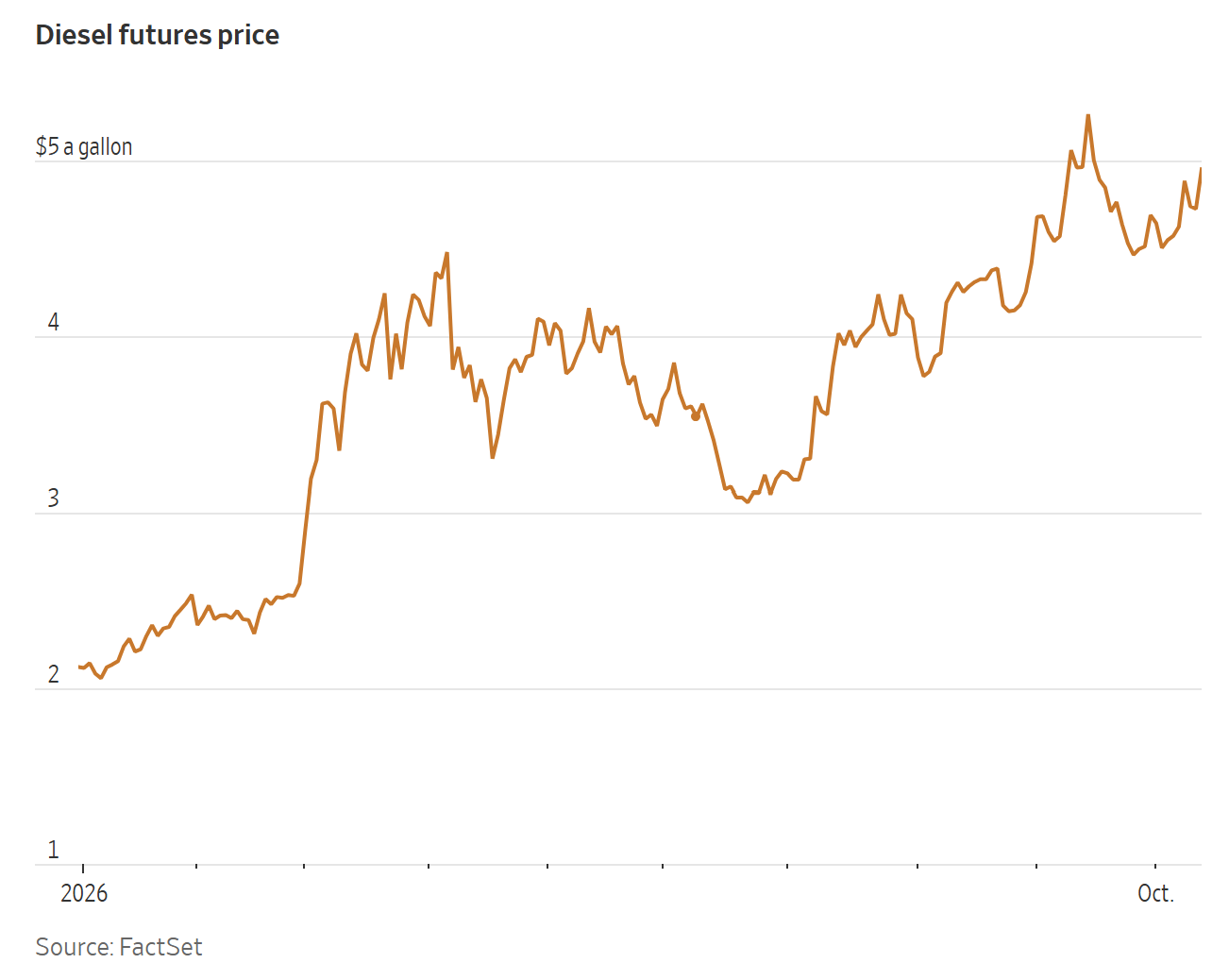
Last Friday, President Trump reversed US foreign policy by announcing an agreement to suspend sanctions on Russian diesel exports in exchange for Russia lifting the export ban imposed during the summer after Ukrainian attacks on its refineries raised concerns about domestic fuel shortages.
In Washington, lawmakers from both parties questioned the agreement’s legality. On Wall Street, energy traders and analysts said the fuel volumes outlined in the agreement were insufficient to meaningfully reduce prices.
National average retail diesel prices, which reached a record $6.53 per gallon in September, stood at $6.28 on Tuesday, slightly above Friday’s level, when the agreement with Russia was announced.
Shortly before 8:30 am EDT yesterday, the Saudi-led coalition announced plans to strike the Yemeni Oil Company site in Sanaa. The Houthis subsequently threatened Saudi energy infrastructure. Early-warning alerts for missile attacks in eastern Saudi Arabia were activated in the early afternoon, followed by reports that the attacks had been intercepted. A further warning was later issued for Riyadh.
Concerns about the vulnerability of Gulf energy infrastructure and shipping lanes remained in focus after Iran-aligned Houthis struck Riyadh’s international airport over the weekend and tanker attacks were reported near the Strait of Hormuz.
Despite continued disruption to shipments through the Strait of Hormuz during the war with Iran, OPEC+ recorded a sharp increase in September production, driven by higher Saudi output, OPEC said on Tuesday. Secondary sources estimated OPEC production at 25.097 million bpd, up 920,000 bpd m/o/m, led by Saudi Arabia and Iraq. Output from non-OPEC members of the Declaration of Cooperation was broadly unchanged m/o/m.
OPEC lowered its 2026 oil demand growth forecast for a sixth consecutive month, but raised its projection for the following year, citing the need to rebuild inventories depleted during the war with Iran.
Hurricane Isaias-related shut-in production in the Gulf of America declined to 329,000 bpd as of 11:00 am CDT, according to the Bureau of Safety and Environmental Enforcement.
For the US Department of Energy’s Weekly Petroleum Status Report, due Thursday, average shut-in production for the week is estimated at approximately 464,000 bpd.
Note: As of 4 pm EDT 13 October 2026
Currencies
EUR +0.35% to $1.1196
GBP +0.33% to $1.3249
Bitcoin +1.18% to $83,471.44
Ethereum +0.88% to $2,510.16
The US dollar retreated from an 18-month high on Tuesday and extended its losses after New York Fed President John Williams said he still expected one further rate increase this year, but saw no need for additional tightening in 2027.
The US Dollar Index fell -0.34% to 102.21 after reaching 102.61 on Monday, its highest level since April 2025.
The euro rebounded from a 17-month low on Tuesday, rising +0.35% to $1.1196 after touching $1.1153 on Monday, its weakest level since May 2025.
The yen strengthened +0.20% to ¥158.29 per US dollar after BoJ data showed wholesale prices increased 6.8% y/o/y in September. Although the reading was below the consensus forecast of 7.6%, it remained consistent with expectations of higher interest rates.
Investor sentiment remained supported by prospects of further BoJ policy tightening and the risk of official intervention to curb excessive currency movements.
The British pound also advanced +0.33% on the day against the greenback to $1.3249.
Fixed Income
US 10-year Treasury -1.4 basis points to 5.223%
German 10-year Bund -1.2 basis points to 3.476%
UK 10-year Gilt +0.5 basis points to 5.456%
The US yield curve bull-flattened on Tuesday as long-term Treasury yields declined and short-term yields remained broadly unchanged, mirroring moves in European government bonds.
The 10-year US Treasury yield touched its lowest level since 2 October before paring the decline. It fell -1.4 bps to 5.223% after reaching 5.173% earlier in the session, its lowest point since early October.
The 30-year US Treasury yield declined -3.9 bps to 5.563% after touching 5.536% earlier. At the front end, the two-year yield, which typically tracks expectations for the Fed funds rate, was unchanged at 4.797% after falling as low as 4.757%.
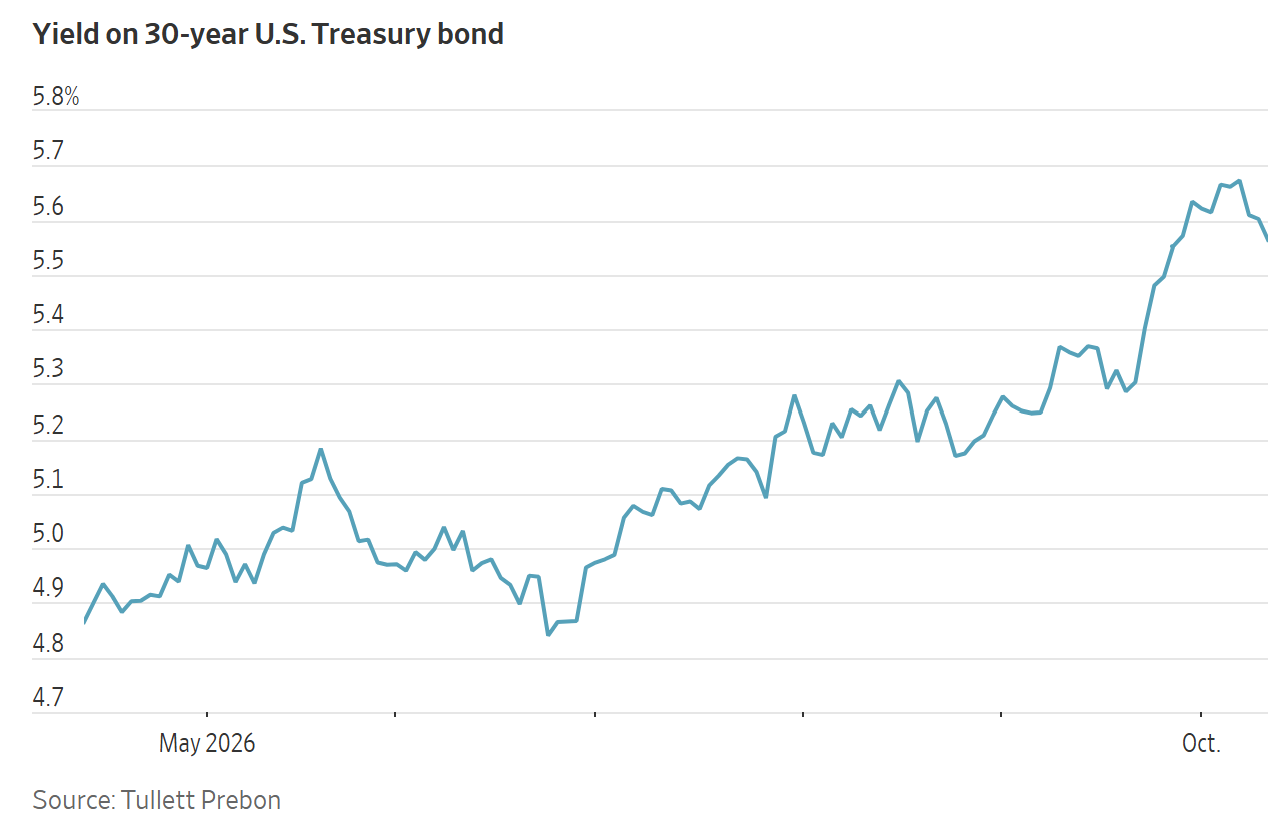
Two weeks before the 27 – 28 October meeting, traders continued to expect the FOMC to keep rates unchanged and defer its next increase until December. The implied probability of an October increase stood at 22.7%, while the probability of a 25 bps move in December was 68.7%, according to CME Group's FedWatch Tool.
The US 2s10s yield curve stood at 42.6 bps.
Eurozone government bond yields, particularly at the long end, declined alongside US Treasury yields on Tuesday.
Germany’s 10-year Bund yield fell -1.2 bps to 3.476% after touching a session low of 3.426%, outperforming the two-year Schatz, whose yield rose +1.6 bps to 3.155%. At the long-end, the German 30-year yield declined by -2.9 bps to 3.816%.
The spread between French and German 10-year yields stood at 135.9 bps, with the 10-year French OAT yield declining -7.0 bps to 4.835%.
Italy’s 10-year BTP yield fell -4.8 bps to 4.528%, leaving its spread over 10-year Bunds at 105.2 bps, 30.7 bps below the French spread.
Italy issued €7 billion across three bonds. Although yields were the highest since 2023, demand remained strong.
Note: As of 4 pm EDT 13 October 2026
While every effort has been made to verify the accuracy of this information, EXT Ltd. (hereafter known as “EXANTE”) cannot accept any responsibility or liability for reliance by any person on this publication or any of the information, opinions, or conclusions contained in this publication. The findings and views expressed in this publication do not necessarily reflect the views of EXANTE. Any action taken upon the information contained in this publication is strictly at your own risk. EXANTE will not be liable for any loss or damage in connection with this publication.
هذه المقالة متاحة لأغراض معلوماتية فقط، ولا ينبغي اعتبارها عرضًا أو التماسًا لعرض شراء أو بيع أي استثمارات أو خدمات ذات صلة يمكن الإشارة إليها هنا. ينطوي التداول في الأدوات المالية على مخاطر كبيرة من الخسارة وقد لا يكون مناسبًا لجميع المستثمرين. الأداء السابق ليس مؤشرًا موثوقًا به للأداء المستقبلي.
 العودة إلى جميع الرؤى








أنشأها المتخصصون. للمحترفين.
