

Fixed Income Briefing November 2026



Renée Friedman, Global Head of Research
Key takeaways
- The dollar remains strong. The dollar index is +0.95% MTD in November driven by rising US Treasury yields and strong economic growth relative to other major economies. In addition, Fed speak has been consistently cautious and increasingly hawkish with Hammack, Logan, Cook, and Kashkari all suggesting the need for further rate rises. However, it is not clear yet if the majority of Fed policymakers are as hawkish as Waller is in considering a 50 bps jump.
- Yields have come back after a temporary drop following the US midterms, with the benchmark 10-year US Treasury +7.9 bps MTD. The increase in rate volatility may be attributed to the lack of forward guidance from Fed Chair Kevin Warsh as well as the realised inflation coming through as the US economy continues to power on still strong consumer demand and the increase in fiscal spending
- Major risks include negotiations between the US and Iran failing with the consequent rise in energy prices and inflationary pressures and the meeting between Trump and Xi becoming more confrontational, resulting in more technology restrictions by the US and China retaliating via the rare earth supply chain, hitting AI stocks and bonds.
Below we review the economic data and bond market performance of the US, Europe, and the UK. We offer facts and ideas for investors to think about and consider the key risks that exist for fixed income investors.
US Economic and Treasury Market Review
- On the labour market front, data released in November suggests that the US economy is far stronger than previous numbers suggested. The US Bureau for Labor Statistics revised the August and September nonfarm payroll figures upwards. August’s numbers were raised by 53,000, from +133,000 to +186,000, while September was revised up by 31,000, from +29,000 to +60,000. The October nonfarm payroll surpassed market expectations, rising to 165,000. The labour force participation rate edged up to 61.9% from September’s 61.8%. The national unemployment rate edged down to 4.1% from September’s 4.2%. More consequential was employment in professional and business services increasing by 70,000 in October, well above the average monthly gain of 15,000 over the prior 12 months. Average hourly earnings were up 0.4% and up 3.1% on an annual basis.
- On the economic growth front, business activity growth continued in October, but at a slower pace. The Final Composite PMI was revised down to 55.9 from the preliminary estimate of 57.6, a drop from September's 58.4, reflecting a slower-than-expected expansion in both the manufacturing and services sectors. It was the lowest in 3 months. The Final Services PMI fell to 56.1 from September’s 58.8 as operating expenses rose sharply due to elevated fuel prices and sentiment regarding future activity fell to its lowest since May. The Final Manufacturing PMI came in at 54.9, down from September’s 52-month high of 55.9 due to rising supply chain and purchasing cost pressures. Yet, business optimism rose to an eight-month high on planned business expansions, signs of market recovery, spending on capital equipment and AI (including data centres), new product launches and better order pipelines
- On the consumer side, US consumer sentiment was down again in October. The University of Michigan Consumer Sentiment Index rose by 6.3% to 51.0, up from October’s 48.0. The Current Economic Situation survey also rose to 51.0, up 9.2% from October’s 48.0, while the Index of Consumer Expectations rose 4.3% to 50.9 from October’s 48.8. Consumers expect prices to rise 4.7% over the next 12 months, up slightly from September’s 4.6% year ahead view. . Year-ahead inflation expectations declined from 4.7% in October to 4.3% this month; it remains substantially above the 3.4% seen in February before the Iran conflict began. Long-run inflation expectations inched down from 3.5% in October to 3.4%
- On the inflation front, headline CPI in October rose to a seasonally adjusted 0.4% in October after rising 0.6% in September according to the Bureau for Labor Statistics (BLS). Core inflation rose +0.3% m/o/m. The BLS didn’t publish year-over-year changes because data collection was interrupted last October during the government shutdown. The energy index increased only 0.7% in October after rising 5.2% in September. The index for gasoline rose 1.0% in October after soaring to 9.1% in September. Services costs, which are closely watched by Fed policymakers as an indicator of longer-run inflation trends, saw a slight increase, with services inflation, less energy, edged down to 0.3% from the previous month’s 0.4%.
Yield swings
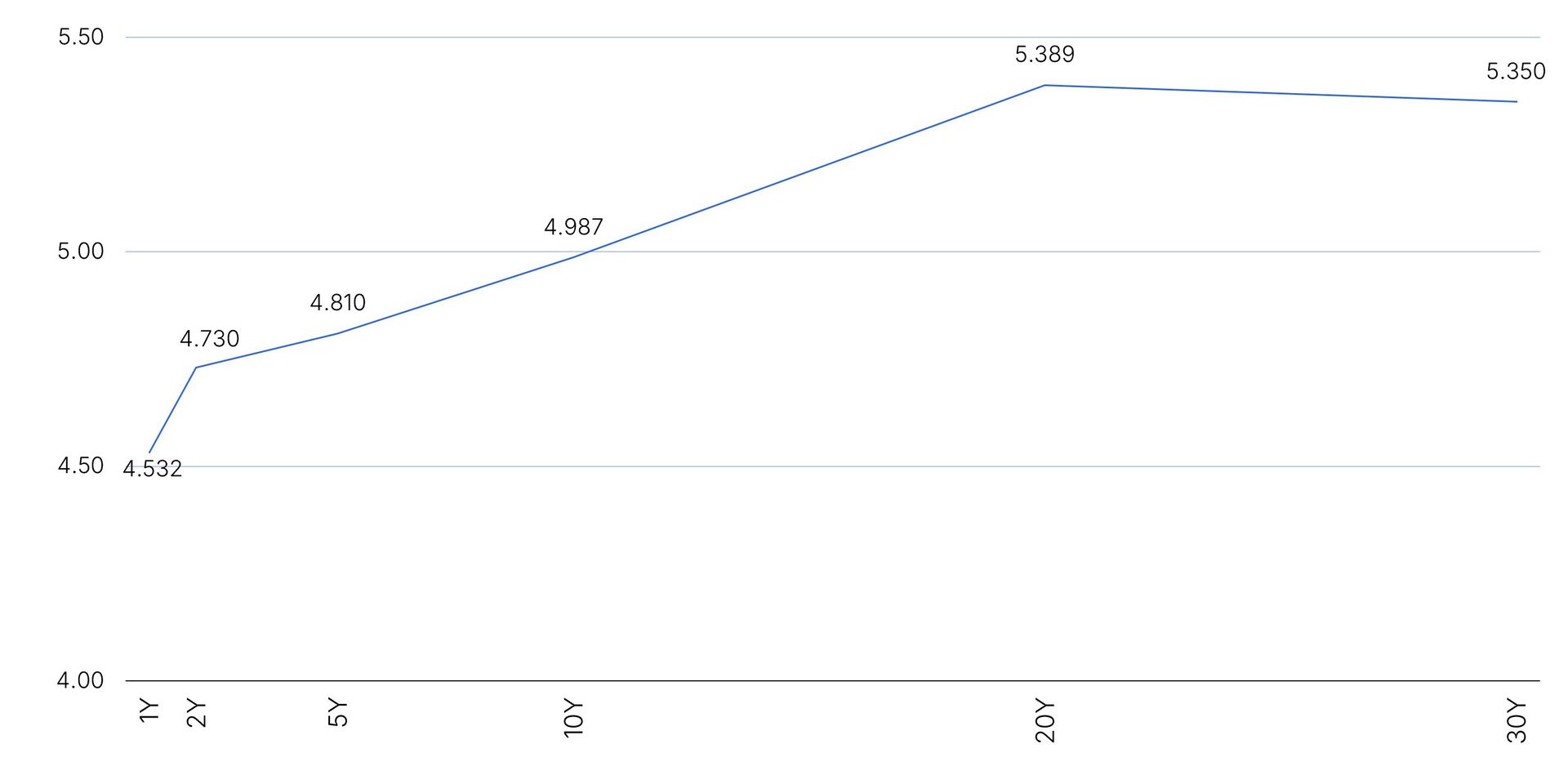
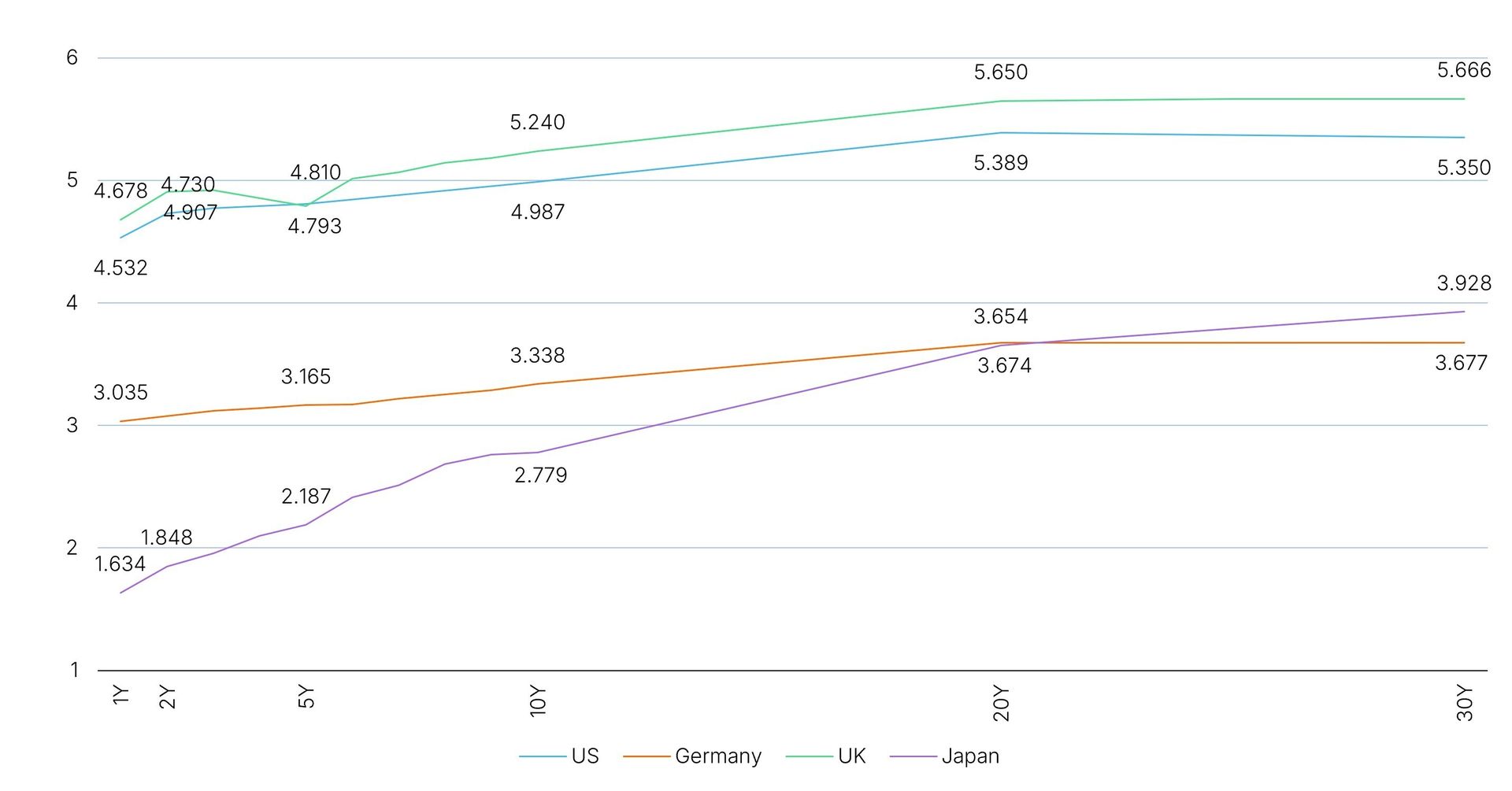
Thus far in November bond markets have seen global bond yields falling. However, Treasuries rallied immediately after the US midterms as investors sought safety, pushing short-term Treasury prices higher. However, yields recovered thereafter, with medium term yields dropping the most, leaving the shape of the yield curve little changed.
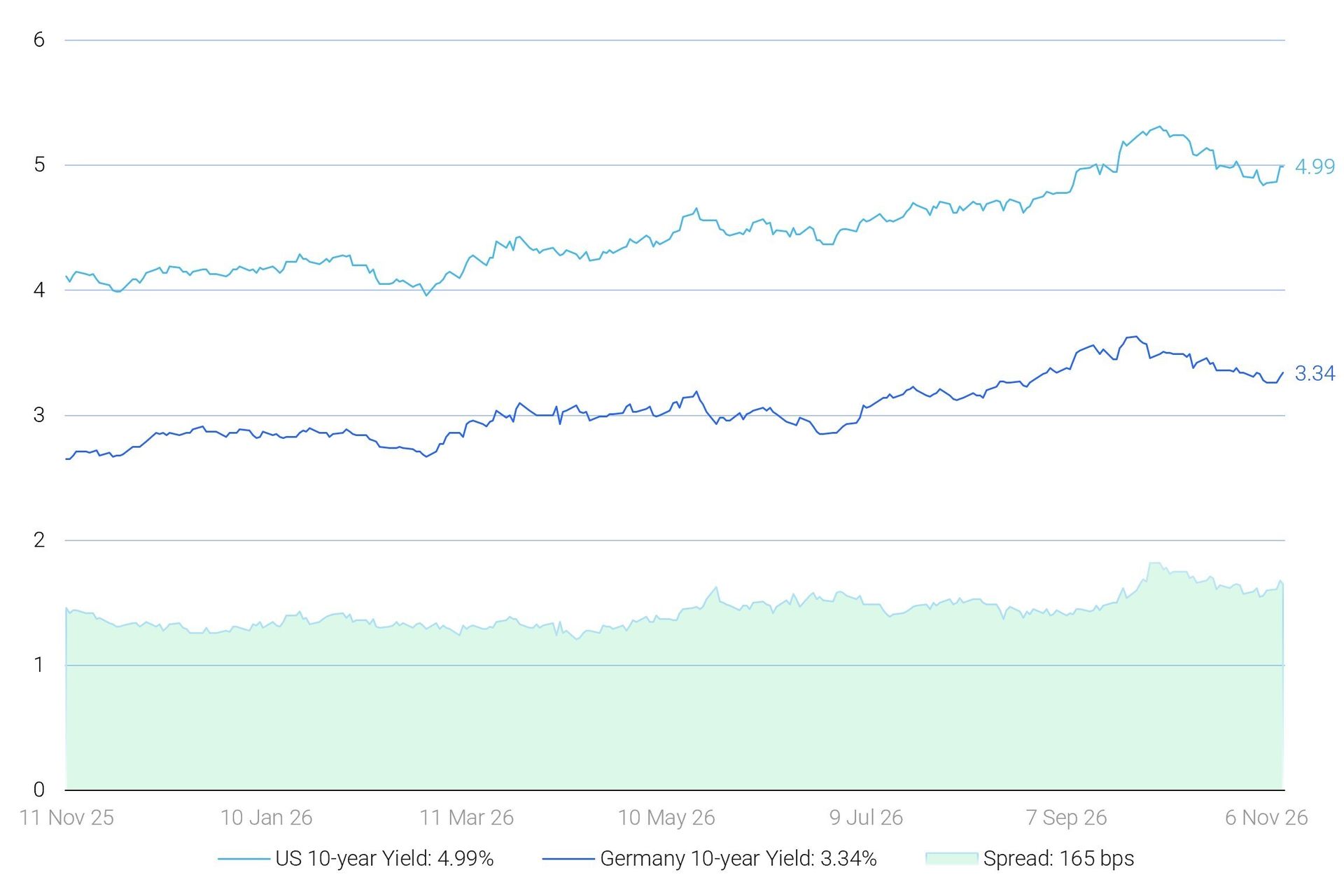
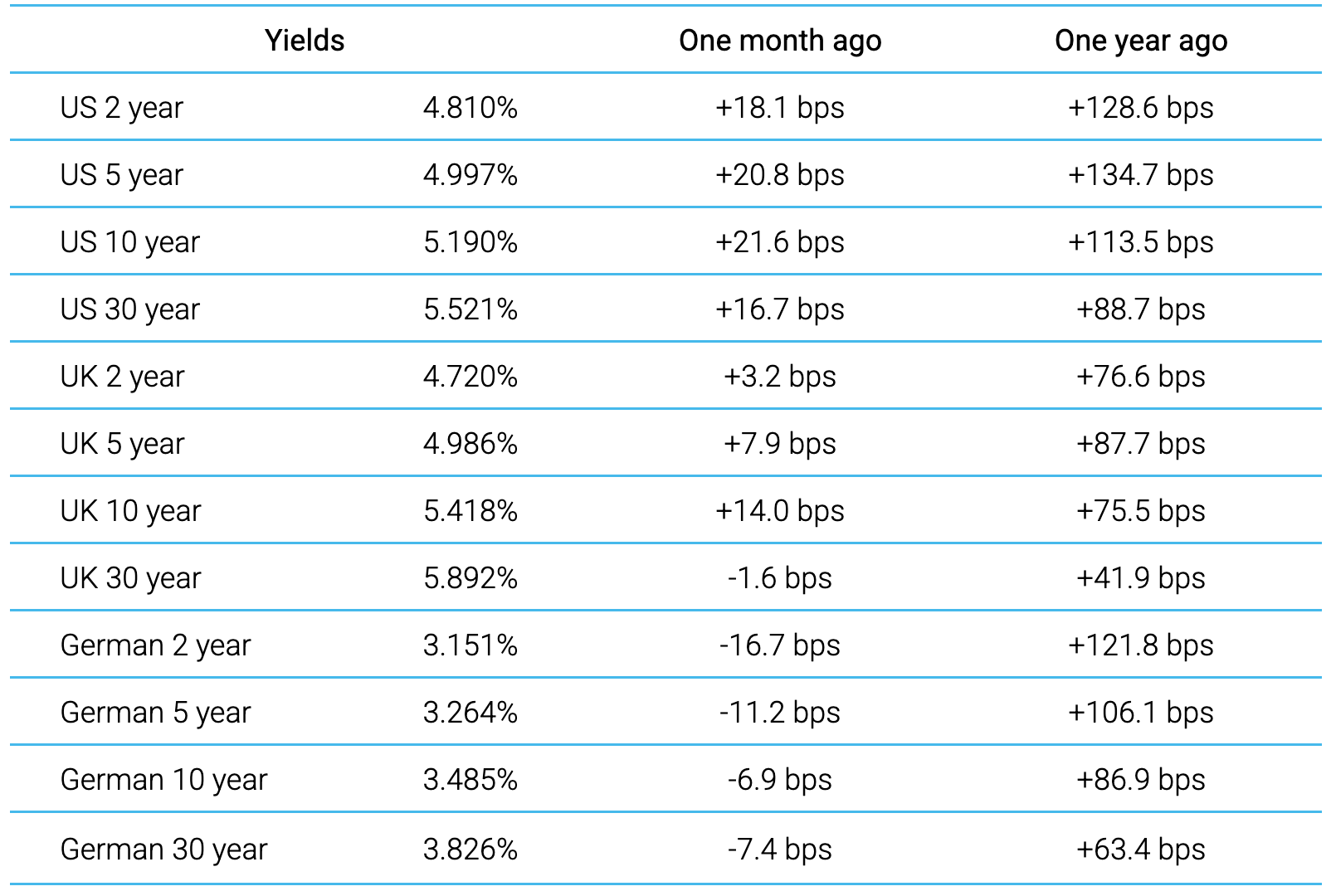
The US 10-year yield is -25.5 basis points (bps) from a month ago, but +7.9 bps MTD. The 10-year German Bund is -14.9 bps from a month ago and flat MTD. The spread between the two has risen to 165 bps, up from the end of October’s 157 bps. On the long-end of the curve, the US 30-year yield is -24.8 bps from a month ago and +5.7 bps MTD, while the German 30-year yield is -17.4 bps from a month ago and -0.7 bps MT.
Source: FactSet
Source: FactSet
Source: FactSet
Source: FactSet 5:00 pm ET 11 November 2026
Global Economic and Market Review
Eurozone
The eurozone economy is still growing. In the third quarter of 2026, seasonally adjusted GDP increased by 0.4 % in the euro area compared to the previous quarter (and by 1.3 % year-on-year), according to the preliminary flash estimate published by Eurostat.
However, eurozone business activity in October signalled a slowdown of economic growth across the euro area. New order receipts slowed as output price inflation remained high. Cost pressures were their sharpest since May. The Final Composite PMI for October came in at 51.7, down from September’s 53.1 reading. Further upward price pressures were reported in October, largely linked to higher energy prices, The Final Services PMI for October fell from 53.0 in September to 51.4, while the Final Manufacturing PMI edged down to 52.7 from September’s 52.9 reading.
On the inflation front, Euro area annual inflation rose to 4.0 % in October 2026, up from 3.8 % in September. While core inflation in October was unchanged on the month at 2.5 %, while the services gauge edged up to 3.3 %. The increasing level of inflation has had ECB policy makers such as President Christine Lagarde and Bundesbank President Joachim Nagel suggesting further rate rises to come. Inflation has, so far, remained concentrated in terms of energy, but there is the risk that it broadens to wages and company selling prices. According to ECB Watch, 95 % of traders are expecting a 25 bps rate hike in the December meeting to 2.75 %, with 68.9 % expecting a further hike to 3.00 % at the February meeting.
United Kingdom
In the UK, the economy has defied fears that surging energy prices and rising interest rates would derail the economy. GDP increased by 0.7 % in the three months to September, according to the Office for National Statistics. It was the fastest pace since 2024 and up from Q 2’s 0.5 %. The growth was led by a 0.9 % expansion in the services sector. Production output grew by 0.1 %, following a fall of 0.5 % in Q2. On a monthly basis, GDP grew by 0.2 % in September, after showing no growth in August. However, the growth in September was driven by a 0.2 % growth in services, with production growing by 0.3 % and construction rising by 0.8 %.
In terms of business growth, the Final S&P Global UK PMI Composite was 52.9 in October, up from 52.0 in September and the highest reading since February. The UK services sector expanded at its fastest pace in eight months during October, driven by stronger customer demand and increased order volumes. The Final S&P Global Services PMI came in at 52.8 in October, up from 52.1 in September. October data indicated that business activity expectations for the year ahead improved for the fourth time in the past five months. The Final S&P Global Manufacturing PMI rose to a five-month high of 52.8 points in October, in line with the flash estimate and up from 51.9 in September. Rates of growth in output and new orders both gathered pace in October, as companies responded to signs of improving demand in both domestic and overseas markets, including new work received from mainland China, the EU and the US. UK business optimism reached an eight-month high in October, with manufacturers citing "planned business expansions, signs of market recovery, spending on capital equipment and AI (including data centres), new product launches and better order pipelines.”
The government’s business insights and conditions survey showed that in October businesses with 10+ employees were concerned about cyber-attacks impacting supply chains over the next 12 months, while 12 % were concerned about artificial intelligence; both proportions are the highest since the question was introduced, in September 2024. Almost 7 in 10 (69 %) businesses with 10+ employees expressed some degree of concern regarding energy prices in late October 2026. In October 31 % of businesses reported that they were concerned about international conflict impacting supply chains over the next year. Of these, 64 % expected the cost of sourcing materials to be impacted, up 9 percentage points from September 2026; 60 % expected transportation costs to be impacted, up 9 percentage points from September 2026 and 27 percentage points from September 2025. Only 21 % were concerned about the impact of shipping disruption. Almost 7 in 10 (69 %) businesses expressed some degree of concern regarding energy prices in late October 2026, broadly stable from early October 2026, but up 6 percentage points from August 2026;
Things to think about
The high yield environment is likely to continue for the foreseeable future, largely due to yields being driven by higher real interest rates due to competition for capital pushing up the neutral rate while the still ongoing war with Iran and higher oil prices have continued to worry traders and central bankers in terms of second round effects. There is also the ongoing war in Ukraine and future geopolitical disruptions from elections in the various eurozone countries in 2027 to consider. The meeting next week between Presidents Donald Trump and Xi Jinping, their third meeting this year, means that investors will be closely watching for any signals on export controls following on from the news that an alleged Chinese spy had an affair with Nvidia’s Jensen Huang, resulting in China gaining access to some AI chips that had been banned by US export rules. The Taiwan question remains tricky; although President Trump suggested in May that US arms sales to Taiwan could be a bargaining chip in talks with China, it is not clear if the new Democrat-controlled Congress coming in January may force Trump to resume arms sales to Taiwan next year. This could destabilise the US - China relationship further. Additionally, there will be expected rises in food price inflation due to geopolitical tensions, still high energy costs, and early El Niño weather patterns.
In the US, expectations of a Fed rate rise in December are pretty much locked in, with the CME FedWatch tool showing an 89 % probability for a rise of 25 bps and an 11 % chance of a 50 bp rise. A stronger than expected jobs market, resilient economic growth and inflation still, almost six years on, remaining above the Fed's 2 % target suggest further tightening is required. Markets will be watching the discussions of the 119th’s Congress final few weeks and the ongoing stalemate over fiscal year (FY) 2027 spending negotiations. With a new congressional session in January, it is unlikely that there will be agreement on a final FY27 spending bill
In the eurozone, energy costs are keeping inflation elevated, while the rise in global borrowing costs is providing some headwinds for policymakers. Markets are pricing in a rate rise in December with a strong possibility of another in February. The significant budget uncertainty in France, along with its rising debt and deficit levels, will likely keep French bond yields higher than its neighbours, although Belgium in particular is also looking vulnerable.
In the UK, the Bank of England raised rates by 25 bps in November to 4.00 %, its first rise since August 2023, and, with growth surprising to the upside despite the energy price pressures, the BoE is likely to raise rates again at least a few more times into 2027. CPI inflation was 3.5 % in September and is set to rise to around 5 % by the middle of next year. That is mostly because of the direct effects of higher global energy prices on fuel and household utility prices. BoE Governor Andrew Bailey said during the press conference following the decision that “Today’s increase should not be seen as the first in an inevitable long sequence of hikes, but unless the conflict in the Middle East is resolved, neither does it seem likely to be the last.”
Geopolitical uncertainty is still high; following the Democrats sweep of the midterms, the new Congress in January is expected to be more sympathetic to supporting Ukraine. Despite the war with Iran damaging Republicans at the ballot box and the return to negotiations by both sides, there is still a not insignificant chance that there could be an escalation in the war with Iran if the Iranians refuse to agree to the nuclear deal and other conditions put forward by the US. The fact that the senior Iranian military and Revolutionary Guards officials issued a series of threats against the United States and Israel today, including a pledge to kill their leaders and warnings of attacks on American bases in Europe and targets worldwide, is a sign of the risk that still remains.
Investors may still wish to focus on selective yield-spread targeting, continuing to diversify across geographies to reduce country-specific risks. However, with central banks generally adopting a more hawkish tone, short-duration paper, in the 2 to 5 year range, remains attractive relative to longer duration bonds which are more exposed to fiscal policy risks, higher debt levels, energy price rises and the consequent inflationary feed through, and political uncertainty. The repricing in the short end has largely occurred and although the Fed may hike at least twice more (December and February) as core inflation could remain firm in the near term, expectations of further rate rises after that may be overblown. Investors may also wish to use inflation-protected securities (e.g., TIPS) which also offer higher yields.
Key risks
- Inflation risks continue to rise, further undermining consumer and business confidence. The ongoing war with Iran and its demands that the US accept its "seven conditions" before substantive negotiations on Iran's nuclear programme can begin means an unlikely quick end to the war. Oil prices could jump even higher if there are more attacks on energy infrastructure both in the Gulf region and in Russia.
- Policy uncertainty. The central banks may get the timing of rate hikes wrong or we may see a faster divergence in policy due to still fragile geopolitical energy dynamics. In Europe, there are continuing concerns around growing regional friction, with the far right RN party likely to win in France’s election next year, increasing uncertainty around Italy’s elections, and the impact across the region of the riots that continue to take place in France and Spain. All of this may influence national and EU wide fiscal policies. In addition, there may be greater than expected divergence across rates and FX if energy insecurity continues in Europe and Asia relative to the US. Fiscal stimulus changes expected in the US and potentially in Europe may create additional volatility in markets.
- Geopolitical tensions, re-alignments and events. Geopolitical risk stemming from the Iran war, the threat to Taiwan from mainland China and the ongoing war in Ukraine, all have the potential to hit supply chains further, with the consequent effects on inflation, bond yields and currency valuations. Despite the increase in oil deliveries from the Middle East, still low energy reserves could allow geopolitical shocks to transmit even more forcefully.
This article is provided to you for informational purposes only and should not be regarded as an offer or solicitation of an offer to buy or sell any investments or related services that may be referenced here. Trading financial instruments involves significant risk of loss and may not be suitable for all investors. Past performance is not a reliable indicator of future performance. Sentiments are generated automatically and are not investment advice.
 Back to all insights








Created by professionals. For professionals.
