

Will AI spending be justified?


 S&P 500 +0.02% last week to 7,413.24 US 10-year yield -3.02 basis points to 4.640% Spot gold +0.73% to $4,082.16 an ounce DXY +0.04% to 101.51
What to look out for today
Companies reporting on Tuesday, 28 July: Boeing, Ford, PayPal, Mondelez, Coca-Cola, Visa, Corning, Waste Management, EcoLab, Teradyne
Key data to move markets today
EU: German Bundesbank “Buba” Monthly Report
USA: ADP Employment Change 4-week average, Housing Price Index and Consumer Confidence
Global Macro Updates
US capital spending rises. New orders for US manufactured capital goods increased strongly in June while shipments surged by the most since 2021 as businesses ramped up spending on artificial intelligence. The AI build-out appears to be providing support to the economy and limiting the impact of the five month war with Iran.
Non-defence capital goods orders excluding aircraft, a closely watched proxy for business spending, rose 0.9% last month after an upwardly revised 1.9% increase in May. Core capital goods orders rose 9.3% year-on-year in June. Machinery orders dipped 0.1%. Shipments of core capital goods, which go into the calculation of the business spending on equipment components in the gross domestic product report, rose 1.9% in July after gaining 0.2% in May.
The durables report showed increased orders for computers, communications and electrical equipment as well as for primary metals. In April the largest tech firms including Meta, Microsoft and Alphabet, suggested they may spend as much as $725 bn on AI this year. All eyes will be on this week’s corporate earnings reports calls from tech players Meta and Microsoft to see if AI spending levels are justified on visible revenue conversion and if it will rise even further.
Core capital goods shipments, a less volatile metric that excludes planes and military hardware, rose 1.9%, the biggest advance since late 2021.
US Stock Indices
Dow Jones Industrial Average +0.42%
Nasdaq 100 -0.32%
S&P 500 +0.02%, with 7 of the 11 sectors of the S&P 500 up
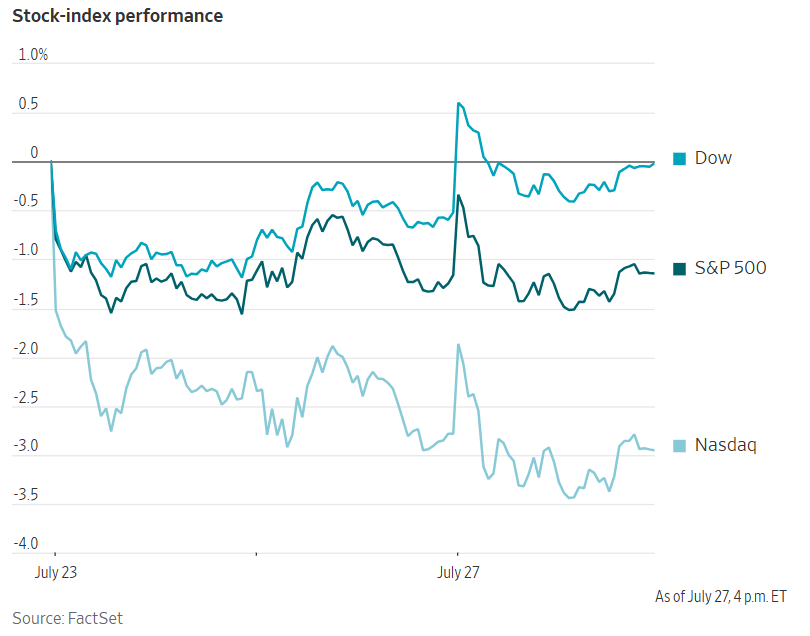
On Monday the S&P 500 edged up +0.02%, or 1.29 points to 7,413.24. The Dow Jones Industrial Average rose +0.42%, or 218.52 points, to 52,186.77. However, the Nasdaq Composite was dragged down by chip stocks, falling -0.17%, or -41.70 points to 24,934.12. The Philadelphia chip index extended its selloff, falling -2.2%. It is down -21% from its record high close on 22 June. However, it is still +63% in 2026.
In corporate news, shares of ASML Holding declined on a report that a Chinese state-backed firm is producing DUV chipmaking tools that could threaten its sales.
Jersey Mike’s Subs initial public offering has attracted investor demand for more than 10 times the available shares ahead of pricing on Wednesday, according to people familiar with the matter.
Nvidia has committed to invest $5 billion in Ilya Sutskever’s Safe Superintelligence (SSI), according to people familiar with the matter. This is expected to boost SSI's available computing resources, the companies said. The deal also gives SSI access to Nvidia's cutting-edge Vera Rubin hardware.
Sarepta Therapeutics appointed former AbbVie executive Michael Severino its new chief executive officer.
Corporate Earnings Reports
Posted on Monday, 27 July from The Pulse, our real-time AI-driven news tool. Available exclusively on the EXANTE Web Platform
AstraZeneca reported Q2 2026 earnings. Revenue was $15.38bn (vs estimate $15.42bn) and core EPS was $2.63 (vs estimate $2.48). The company reconfirmed its revenue and core EPS guidance for FY and remains on track to deliver its ambition of $80bn in revenue by 2030.
European Stock Indices
CAC 40 +0.40%
DAX +1.04%
FTSE 100 +0.42%
Commodities
Gold spot +0.73% to $4,082.16 an ounce
Silver spot +0.76% to $58.62 an ounce
West Texas Intermediate -8.21% to $81.98 a barrel
Brent crude -9.13% to $87.77 a barrel
Gold prices rose on Monday due to a significant drop in crude oil prices which helped ease bond yields on lower inflation fears. Spot gold was + 0.73% to $4,082.16 an ounce.
Spot silver was +0.76% to $58.62 per ounce.
Crude oil futures fell on Monday to a one-week low after President Donald Trump said Washington was having "good talks" with Iran and there was a chance of a peace deal. However, he warned that the US would resume strikes if the negotiations failed to deliver. Mike Waltz, the US ambassador to the UN, said on Sunday that President Trump was “giving the talks some space” before deciding whether to resume strikes.
Brent futures fell as much as 9.5% before paring some of its losses to settle -9.13%, at $87.77 a barrel. WTI crude futures fell -8.21%, to close at $81.98,
However, Saudi Arabia, Jordan and Iraq reported drone attacks on Monday with Saudi Arabia's air defences intercepting and destroying drones launched from Iraq. Yemen's Houthis claimed they had targeted sensitive crude oil supply and transport sites linking eastern Saudi Arabia to the critical Red Sea oil export hub of Yanbu. According to the Financial Times, Yahya Sare’e, a spokesperson for the Houthis, said the operation was in response to what he described as a Saudi Arabian drone attack on Yemeni airspace.
Flows through the Strait of Hormuz remain exceptionally low, with fewer than 10 commodity vessels passing through the Strait of Hormuz daily during the weekend, shipping data from Kpler showed.
In addition, ship traffic through the Bab el-Mandeb strait fell on Sunday after Yemeni Houthis attacked Saudi oil installations along the Red Sea coast, although a third Chinese supertanker exited via the waterway.
According to Reuters, Kazakhstan has more than halved its daily oil output following the closure of the main exporting terminal in Russia's Black Sea over drone attacks, an industry source said on Monday. The energy ministry later said the Caspian Pipeline Consortium's Black Sea terminal had resumed oil loadings.
Note: As of 4 pm EDT 27 July 2026
Currencies
EUR +0.02% to $1.1373
GBP -0.21% to $1.3295
Bitcoin +0.46% to $64,938.00
Ethereum +1.87% to $1,947.63
The US dollar rose slightly up on Monday as traders positioned themselves cautiously ahead of this week’s FOMC meeting where a rate rise cannot be ruled out. The dollar index rose +0.04% to 101.51.
The euro was largely unchanged, edging up +0.02% to $1.1373. Sterling was down -0.21% to $1.3295.
The dollar fell -0.07% against the yen to ¥163.73, largely due to the pause in US military strikes in Iran, which caused oil prices to plunge, thereby reducing safe-haven demand for the dollar.
Fixed Income
US 10-year Treasury -3.02 basis points to 4.640%
German 10-year Bund -4.5 basis points to 3.144%
UK 10-year Gilt -6 basis points to 4.990%
US Treasury yields fell on Monday as oil prices plummeted following a suspension of US air strikes against Iran. The 2-year note yield, which moves closely with Fed funds rate expectations, fell -2.5 bps to 4.327%. The US 10-year note yield declined -3.02 bps to 4.640%.
The US Federal Reserve is expected to hold rates steady at the end of its meeting on Wednesday. However, traders do see a risk of a hike after the recent rise in oil prices reignited inflation concerns, with the lack of forward guidance by Fed Chair Kevin Warsh adding to the uncertainty.
Monday's $69 bn sale of 2-year notes hit a high yield of 4.315% with a bid-to-cover ratio of 2.66X, higher than the previous 2.64X, drawing soft demand amid broader market focus on this week’s Federal Reserve meeting. The yield came in 0.5 basis points lower than what the market expected right before the auction. The $70 bn sale of 5-year notes came in at a high yield of 4.408% on weak demand, with a bid to cover of 2.28X vs the average of 2.33X, tailed by 0.9 basis points.
Fed funds futures traders are currently pricing in 38% odds of a hike on Wednesday and an 83% probability of an increase by September.
Eurozone bond yields also fell on Monday as easing oil prices, following President Trump’s decision to halt strikes against Iran, helped soothe short-term inflation fears.
Germany's two-year yield, more sensitive to ECB policy rate expectations, fell -4.3 basis points to 2.777%. Germany's 10-year government bond yield was down -4.5 bps at 3.144%.
Money markets slightly scaled back bets on ECB rate hikes, pricing a deposit rate of 2.68% in December and 2.73% in February 2027 from the current 2.25%. Last week, they fully priced a deposit rate at 2.75%.
Italy’s 10-year government bond yields fell -6 bps to 3.942%. The spread between Italian government bonds and Bunds was at 79 bps. It stood at 63 bps in February before the attack on Iran, and hit 103.62 in late March, the highest level since June 2025.
Note: As of 4 pm EDT 27 July 2026
While every effort has been made to verify the accuracy of this information, EXT Ltd. (hereafter known as “EXANTE”) cannot accept any responsibility or liability for reliance by any person on this publication or any of the information, opinions, or conclusions contained in this publication. The findings and views expressed in this publication do not necessarily reflect the views of EXANTE. Any action taken upon the information contained in this publication is strictly at your own risk. EXANTE will not be liable for any loss or damage in connection with this publication.
This article is provided to you for informational purposes only and should not be regarded as an offer or solicitation of an offer to buy or sell any investments or related services that may be referenced here. Trading financial instruments involves significant risk of loss and may not be suitable for all investors. Past performance is not a reliable indicator of future performance.








Created by professionals. For professionals.
