

When tough words are not enough


 S&P 500 -0.87% to 7,641.16 US 10-year yield +5.6 basis points to 4.706% Spot gold -0.07% to $4,517.87 an ounce DXY +0.07% at 98.87
Key data to move markets today
EU: Eurozone Consumer Confidence, German, French and Eurozone HCOB Composite, Services and Manufacturing PMIs
UK: Retail Sales, Retail Sales ex-Fuel, S&P Global Services, Manufacturing and Composite PMIs
USA: S&P Global Services, Manufacturing and Composite PMIs
Global Macro Updates
Treasury’s attempt at term premium control. As reported by The Wall Street Journal, this year’s rising bond yields reflect persistent inflation and heavy AI-related corporate borrowing, but more concerning is that US Treasuries are losing their traditional appeal as the world’s preferred safe asset. They no longer consistently yield less than comparable securities and occasionally fail to act as havens during market stress.
The US Treasury’s surprise Wednesday announcement to increase buybacks of less-liquid, longer-dated debt treats symptoms rather than causes. While short-term yields might drop, the move could ultimately drive them higher by eroding perceptions of US fiscal stability and policy predictability.
Historically, Treasuries enjoyed a safety premium. Demand for highly secure assets outstripped supply, lowering US borrowing costs. Post-pandemic inflation and swelling deficits shattered this dynamic. MIT economist Ricardo Caballero argues the traditional ‘safe-asset shortage’ has been replaced by an ’absorption premium.’ Investors now demand higher yields to absorb the mounting supply of government debt, now running at $40 trillion and taking up approximately a fifth of US government tax receipts. Consequently, Treasuries recently began yielding more than swap rates and the term premium has steadily risen.
Stanford economist Hanno Lustig notes similar trends. Since 2022, Treasuries have lost their historical yield advantage over AAA-rated corporate bonds and comparable dollar-hedged sovereign debt. Furthermore, stock-market declines and widening deficit expectations now tend to push yields higher, signalling reduced haven demand during periods of stress.
Despite a projected $2.1 trillion deficit and a record $1.9 trillion in expected corporate issuance, Treasury Secretary Bessent has prioritised market management over addressing these fundamentals. Relying heavily on short-term bills, smaller auctions and buybacks departs from the Treasury’s historical emphasis on regular, predictable issuance. Wednesday’s announcement, arriving just two weeks after the quarterly refunding, blindsided investors.
If debt issuance becomes less predictable, bond-market volatility will likely rise, prompting investors to demand even higher yields. Furthermore, a heavier reliance on Treasury bills heightens refinancing risk, leaving future officials to manage the inevitable fallout.
US Stock Indices
Dow Jones Industrial Average -1.32%
Nasdaq 100 -0.72%
S&P 500 -0.87%, with 9 of the 11 sectors of the S&P 500 down
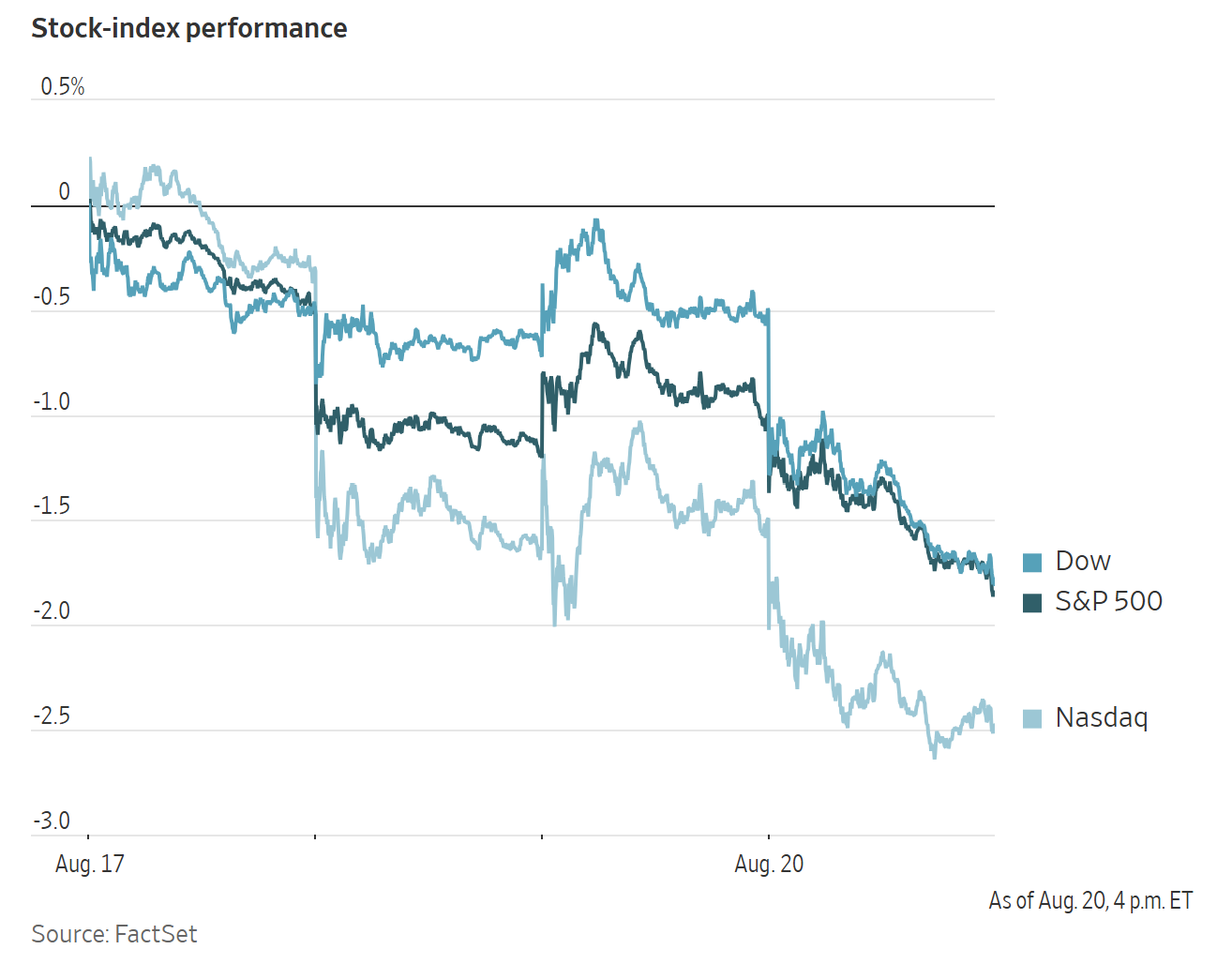
US equities declined on Thursday, pressured by Walmart’s weaker earnings report and renewed concerns over rising bond yields. The Dow fell 703.84 points, or -1.32%, while the Nasdaq declined -1.00% to 26,067.17 and the S&P 500 slipped -0.87% to 7,641.16.
Walmart was among the weakest performers across major indices, falling 9.16% as sluggish sales growth raised concerns about consumer resilience. American Express, Home Depot and Amazon each declined more than two percent, while consumer staples and consumer discretionary shares ranked among the weakest sectors in the S&P 500.
Walmart reported that Q2 US comparable sales increased 2.6%, marking the retailer’s smallest quarterly gain since 2020. The result was weighed down by new pharmacy-pricing regulations; excluding that impact, Walmart said comparable sales would have risen 3.4%, still below analysts’ expectations for a 3.8% increase, according to FactSet.
Investor scrutiny focussed largely on US comparable sales excluding fuel, which rose 2.6% versus consensus expectations of 3.5%, driven by 1.5% traffic growth and a 1.1% increase in average ticket. Attention also centred on softer Q3 EPS guidance and the scale of the full-year EPS guidance increase, although the company noted that tariff refund reinvestments were a factor.
Despite the softer underlying sales trends, Walmart raised its full-year outlook for both net sales and operating income. The company now expects net sales to increase 4.0% to 5.0% for the full year, up from its prior forecast of 3.5% to 4.5%, while operating income is projected to rise 7.0% to 8.5%, compared with the previous 6.0% to 8.0% range.
In corporate news, Bloomberg news reported that Broadcom is in discussions with lenders to raise more than $60 billion in debt to support an AI chip financing transaction that would benefit Anthropic PBC and other companies. The financing could include an approximately $30 billion junior debt tranche, alongside a senior-secured tranche ranging from about $60 billion to $70 billion. Blackstone and Apollo Global Management are also in talks with Broadcom to participate in the transaction, building on a partnership the three firms established in June to help finance computing infrastructure. According to people familiar with the matter, the debt would be issued through a special-purpose vehicle.
Bloomberg news also reported that Anthropic PBC expects to match or exceed the size of SpaceX’s record-setting initial public offering, according to people familiar with the matter. The company is reportedly evaluating potential proceeds as it prepares to file publicly for a possible large-scale IPO as soon as the end of this month, although discussions remain ongoing and details could change. Anthropic raised $65 billion in May at a $965 billion valuation.
Super Micro Computer completed an independent investigation into allegations involving the smuggling of Nvidia chips into China. The investigation concluded that the company’s current senior management had no knowledge of the alleged scheme.
Corporate Earnings Reports
Posted on Thursday, 20 August from The Pulse, our real-time AI-driven news tool. Available exclusively on the EXANTE Web Platform
Walmart reported Q2 FY27 results. Revenue rose +5.9% y/y to $187.9bn (beat estimates of $186.7bn) and adjusted EPS of $0.81 (beat $0.74). US comparable sales ex-fuel grew +2.6%, the slowest in six years and below the +3.67% estimate, partly due to pharmacy deflation. E-commerce rose +23% y/y and advertising +38%. FY27 adjusted EPS guidance was raised to $2.80-$2.87 from $2.75-$2.85, but Q3 guidance of $0.62-$0.64 missed the $0.68 consensus. CEO Doug McMillon said the business model is strengthening and durable. CFO John David Rainey said Walmart will use tariff refunds to lower product costs from Q3. Freedom Broker upgraded the stock to Buy with a $124 price target. The company noted that its AI assistant Sparky saw usage up +70% y/y, with users spending 40% more per order.
Deere reported Q3 results ahead of the open, beating estimates with EPS of $5.10 (vs $4.71 expected) and revenue of $11bn (vs $10.7bn expected). Revenue rose +6% y/y and EPS grew +7% y/y. The company raised its full-year net income outlook to $4.75bn-$5bn from $4.5bn-$5bn, driven by strength in construction and forestry equipment sales, which rose +18% y/y. Management noted the company sees 2026 as the bottom of the current ag equipment cycle and cited improving used-equipment inventories and technology adoption as positive signals.
Alibaba reported Q1 FY27 revenue of ¥268.95bn (est. ¥268.52bn), up +9% y/y, but adjusted EPS of ¥8.52 missed estimates of ¥11.28. Net income fell -75% y/y to ¥10.4bn, weighed by a +75% jump in capex to ¥67.7bn. Alibaba Cloud external revenue growth accelerated to +45% y/y to ¥7.1bn, with AI-related product revenue delivering triple-digit growth for the 12th consecutive quarter. CEO Wu Yongming stated that AI+cloud revenue growth would accelerate and profitability improve over the next several quarters, driven by rising demand for tokens and GPU compute. Benchmark reiterated its Buy rating and $220 price target. Separately, Alibaba agreed to sell its Lingxi Games unit to Trustar Capital for at least $1.5bn to fund its AI push.
Ross Stores reported Q2 2026 revenue of $6.3bn vs $6.15bn expected, up +13% y/y. EPS was $2.66, including a $0.60 benefit from IEEPA tariff refunds. Comparable store sales rose +10% y/y. Net income was $851mn, up +68% y/y. The company raised its full-year FY26 EPS guidance to $8.61-$8.77 vs $7.78 consensus. For Q3, EPS guidance is $1.75-$1.83 (est $1.73) with comp sales growth of +6% to +7%. For Q4, EPS guidance is $2.17-$2.26 with comp sales growth of +4% to +5%. Operating margin expanded +610bps. Ross opened 47 new stores in Q2 and plans 115 for the full year. It repurchased $319mn in shares. The CEO commented that despite facing significantly more challenging year-over-year comparisons in the back half, the company is raising its outlook for both the third and fourth quarters.
European Stock Indices
CAC 40 -0.57%
DAX -0.42%
FTSE 100 +0.04%
Commodities
Gold spot -0.07% to $4,517.87 an ounce
Silver spot +1.60% to $67.99 an ounce
West Texas Intermediate +0.85% to $86.73 a barrel
Brent crude +1.78% to $93.20 a barrel
Gold declined slightly on Thursday.
Spot gold retreated -0.07% to $4,517.87 per ounce, 19.75% lower than the 5,594.82 record high reached earlier this year.
Spot silver advanced +1.60% to $67.99 per ounce.
WTI and Brent advanced for a fifth consecutive session as the global crude market tightened further, with tanker traffic through the Strait of Hormuz remaining limited.
Brent crude futures settled at $93.20 per barrel, up $1.63, or +1.78%. US WTI crude futures rose $0.73, or +0.85%, to $86.73 per barrel.
The US President announced on Wednesday evening plans to increase economic pressure on Iran and warned that countries seeking to provide Tehran with a financial lifeline would face economic consequences. US Treasury Secretary Scott Bessent said the US intends to economically collapse the Iranian regime.
On Thursday, Yemen’s Houthis claimed to have attacked an airport and an Aramco facility in Najran, Saudi Arabia. Separately, after stabilising in July, crude-on-water levels have fallen by 200 million barrels over the past four weeks.
Ukraine struck another Russian refinery, this time in the Tatarstan region, while additional reports on Thursday pointed to widening gasoline shortages in Russia.
US diesel prices reached $188 per barrel today, their highest level since early April.
Norwegian oil production averaged 1.776 million bpd in July, down 2.6% m/o/m and below the Norwegian Offshore Directorate’s estimate of 1.815 million bpd. Output was also down 9.9% y/o/y.
Singapore product stockpiles fell by 768,000 barrels w/w to 37.673 million barrels.
As reported by Reuters, China’s July crude imports by country, in million metric tons, were as follows: Russia at 9.15, equivalent to around 2.16 million bpd; Saudi Arabia at 5.33; Brazil at 4.98; Indonesia at 3.15, reflecting ship-to-ship transfers from Iran; the UAE at 2.43 and Angola at 2.38.
Note: As of 4 pm EDT 20 August 2026
Currencies
EUR +0.00% to $1.1676
GBP +0.19% to $1.3631
Bitcoin +4.33% to $72,726.96
Ethereum +1.38% to $2,317.46
The US dollar traded slightly higher against peers on Thursday, +0.07% at 98.87
The euro was flat against the US dollar to $1.1676, reaching its highest level in more than two-and-a-half months.
Sterling advanced +0.19% against the US dollar to $1.3631, its strongest level since 16 February.
The Japanese yen declined -0.59% to ¥159.05 per US dollar.
Fixed Income
US 10-year Treasury +5.6 basis points to 4.706%
German 10-year Bund -0.5 basis points to 3.275%
UK 10-year Gilt -4.5 basis points to 5.007%
US Treasury yields retraced part of the previous session’s decline on Thursday, resuming their upward trajectory despite renewed assurances from Treasury Secretary Scott Bessent that liquidity support would be provided for long-dated notes and bonds. His comments followed the Treasury Department’s Wednesday announcement of expanded buyback operations.
The move underscored ongoing pressure on long-term borrowing costs in the US, where sovereign debt has surpassed $40 trillion for the first time.
On Thursday, US Treasury Secretary Scott Bessent told CNBC that buybacks could exceed the initially announced $4 billion. Bond markets showed limited reaction, with yields broadly holding their levels, as investors continued to place greater weight on economic fundamentals than on Treasury signals or near-term headlines.
In the early afternoon, the US Treasury auctioned $9 billion of 30-year Treasury Inflation-Protected Securities (TIPS). The high real yield was 2.973%, below the 2.991% when-issued level. It marked the highest real yield for this maturity since October 2001. The bid-to-cover ratio stood at 2.82x, while strong international demand absorbed 84.4% of the issue. The auction came shortly after the Treasury announced that it would double long-end buyback operation sizes starting in September.
Otherwise, limited economic data left markets with few catalysts during late-summer trading.
The yield on the US 10-year Treasury note rose +5.6 bps to 4.706%, while the 30-year bond yield increased +5.6 bps to 5.251%. The two-year US Treasury yield, which typically tracks Fed funds rate expectations, rose +2.9 bps to 4.202%.
The 2s10s yield curve steepened by 2.7 bps to 47.7 bps.
Eurozone government bond yields were broadly steady on Thursday.
Germany’s 10-year bond yield declined -0.5 bps to 3.275%, after closing +0.4 bps higher on Wednesday, while the 30-year yield edged down -0.1 bps to 3.761%. German two-year Schatz yields fell -1.1 bps to 2.860%.
Market pricing for an ECB rate hike remained near its highest level since the start of the Middle East conflict on 28 February. Money markets fully priced the deposit rate at 2.75% by March next year, up from the current 2.25%, and also assigned roughly a 25% probability to a 3.00% deposit rate by March.
The yield spread between 10-year Italian BTPs and Bunds stood at 79.2 bps, below the 85.1 bps spread between 10-year French OATs and Bunds.
Note: As of 4 pm EDT 20 August 2026
While every effort has been made to verify the accuracy of this information, EXT Ltd. (hereafter known as “EXANTE”) cannot accept any responsibility or liability for reliance by any person on this publication or any of the information, opinions, or conclusions contained in this publication. The findings and views expressed in this publication do not necessarily reflect the views of EXANTE. Any action taken upon the information contained in this publication is strictly at your own risk. EXANTE will not be liable for any loss or damage in connection with this publication.
This article is provided to you for informational purposes only and should not be regarded as an offer or solicitation of an offer to buy or sell any investments or related services that may be referenced here. Trading financial instruments involves significant risk of loss and may not be suitable for all investors. Past performance is not a reliable indicator of future performance.







Created by professionals. For professionals.
