

Trump’s trade wars continue

 S&P 500 -0.28% to 7,652.86 US 10-year yield -3.5 basis points to 4.701% Spot gold +0.97% to $4,651.27 an ounce DXY +0.194% to 99.01
What to look out for today
Companies reporting on Tuesday, 25 August: Intuit, Zoom Video Communications, Dick’s Sporting Goods
Key data to move markets today
EU: German GDP and German IFO Business Climate, Current Assessment and Expectation surveys
USA: ADP Employment Change 4-week Average, Consumer Confidence, Housing Price Index and New Home Sales Change
Global Macro Updates
Trump’s tariffs continue. On Monday President Trump said he will increase tariffs on Canadian cars and automotive parts to 50% starting 1 January 2027. The US currently charges tariffs of 25% on Canadian automotive imports. For vehicles covered by the USMCA trade agreement, the levy only applies to non-US parts.
Writing on his Truth Social platform, he stated that “Canada will be treated like a State no longer! On Trade, and in other ways, also, they are among the worst Nations in the World to deal with. They feel entitled, and yet, WE DON’T NEED CANADA, THEY NEED US!”
On Saturday Canadian Prime Minister Mark Carney said that Washington had “miscalculated” and vowed to match the additional US levies “dollar for dollar”. “You’re at war when you’re attacked, and we got attacked,” he said. He said that retaliatory Canadian tariffs on US goods would come into effect on 8 September.
The Canadian dollar weakened -0.56% versus the US dollar to C$1.385 per dollar on Monday.
In addition, according to a Bloomberg news report, the US is set to impose a 7.5% tariff on Chinese goods over allegations of excess manufacturing capacity before a planned summit between Xi Jinping and Donald Trump next month. This would restore Trump’s second-term duties on China to around 20%, a level Beijing has previously said is consistent with its trade truce with Washington.
New US sanctions against Iran. On Monday Treasury Secretary Bessent announced "Operation Economic Outcast," introducing sanctions against nearly 60 Iranian entities, individuals and vessels. There are also new sectoral sanctions targeting digital assets,technology, gold, aviation and shipping that he claimed the Iranian government is using to prop up its economy. He unveiled what he described as an "economic D-Day" that aims to give a final warning to countries to sever their business ties with Iran or risk having key companies and entities cut off from the dollar-based financial system.
During a press conference he said, "We are launching an economic onslaught against Iran’s financial connections around the globe.Our objective is to sever every economic lifeline that sustains this tyrannical regime until Tehran stands alone."
The US has had sanctions against Iran for decades, the majority of which have been focussed on curtailing the country's oil revenues, aviation sector, cryptocurrency, procurement of weapons components and other military hardware and cutting off funding for businesses controlled by the Islamic Revolutionary Guard Corps (IRGC).
Iran had threatened both a military response and further reduction in oil exports from the Gulf in response to any US economic measures. After the announcement by the US, Iranian Economy Minister Ali Madanizadeh was reported to have said, "We are fully prepared for the US sanctions." He is also reported to have stated that neither China nor Russia accepted the US measures.
US Stock Indices
Dow Jones Industrial Average +0.26%
Nasdaq 100 -0.98%
S&P 500 -0.28%, with 8 of the 11 sectors of the S&P 500 up
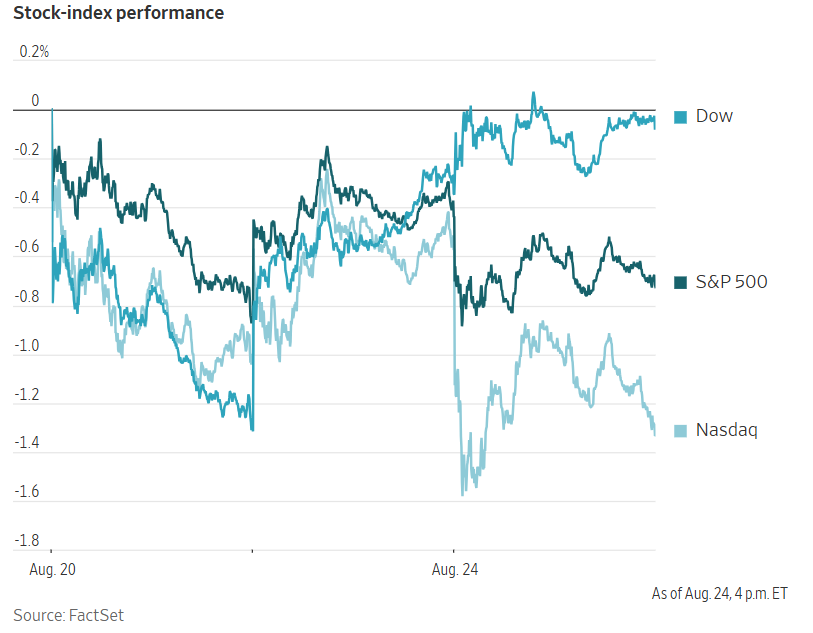
US equities were mixed on Monday as chip stocks sold off, pushing the Philadelphia SE Semiconductor index lower. Nvidia, Micron Technology and Broadcom all fell, putting pressure on the S&P 500 Technology sector.
The Dow Jones was up 140.15 points, or +0.26%, to 53,417.16, while the Nasdaq Composite fell -0.76%, or down 200.06 points to 25,980.19. The S&P 500 declined -0.28%, or down 21.51 points to 7,652.86.
In corporate news, SoftBank Group is planning a ¥1 trillion ($6.3 billion) retail bond sale to raise funds for its investment commitments to OpenAI.
Alibaba Group Holding raised HK$80 billion in Hong Kong’s biggest follow-on offering, showing its willingness to spend vast amounts to take the lead in global artificial intelligence.
According to Bloomberg news, Elon Musk says SpaceX’s first AI satellites, powered by Nvidia’s chips, will initially launch in the fourth quarter of next year and hit “significant scale” in 2028.
European Stock Indices
CAC 40 -0.37%
DAX -0.11%
FTSE 100 +0.35%
Commodities
Gold spot +0.97% to $4,651.27 an ounce
Silver spot +1.60% to $68.94 an ounce
West Texas Intermediate -2.35% to $85.01a barrel
Brent crude -2.35% to $92.17 a barrel
Gold prices rose to their highest levels in more than three months as technical buyers bought following the US Treasury's buyback announcement. Gold was also supported by concerns over US national debt and anticipation of the Fed’s Jackson Hole meeting later this week.
Spot gold +0.97% to $4,651.27 an ounce. US gold futures rose +1.01% to $4,670.90 an ounce.
Spot silver was +1.60% to $68.94 per ounce.
WTI and Brent were down on Monday as investors took profits after recent gains and shrugged off expansionary secondary sanctions by the US against entities and countries that maintain business ties with Iran.
Brent crude futures settled down $2.22, or -2.35%, to $92.17. WTI crude futures fell $2.05 a barrel, down -2.35% at $85.01.
Iran had condemned US plans to announce new sanctions and President Masoud Pezeshkian had called for a diplomatic solution.
Shipping in the Strait of Hormuz remains restrained with fewer than 20 commodity vessels transiting the Strait at the weekend, shipping data showed on Monday. This is due to Iranian and US blockades restricting traffic.
According to Reuters, TotalEnergies Chief Executive Patrick Pouyanne said the oil company was profitably moving oil through the Strait of Hormuz, with higher transport costs more than offset by steep discounts from crude producers. Iraq's SOMO and QatarEnergy both offered crude for loading inside the strait in tenders.
The head of the International Energy Agency (IEA), Faith Birol, said that the IEA is not currently discussing a second release of oil from strategic reserves.
Note: As of 4 pm EDT 24 August 2026
Currencies
EUR -0.15% to $1.1662
GBP -0.10% to $1.3629
Bitcoin +1.96% to $78,922.69
Ethereum +0.99% to $2,474.55
The US dollar traded up on Monday following US Treasury Secretary Scott Bessent announcing secondary sanctions against Iran and entities that do business with Iran, The dollar index was up +0.194% to 99.01.
The euro declined -0.15% to $1.1662. Sterling was also down, falling -0.10% to $1.3629.
The dollar strengthened +0.13% against the Japanese yen to ¥159.13 per US dollar.
Fixed Income
US 10-year Treasury -3.5 basis points to 4.701%
German 10-year Bund -0.6 basis points to 3.270%
UK 10-year Gilt -1.4 basis points to 5.051%
US Treasuries rallied on Monday on weaker oil and after CNBC reported that Treasury Secretary Scott Bessent could tap the department's near $1 trillion General Account to help fund bond buybacks.
The yield on the US 10-year Treasury note fell -3.5 basis points to 4.701%. The 30-year bond yield declined -4.6 basis points to 5.230%. The two-year US Treasury yield, which typically tracks Fed funds rate expectations, edged down -0.2 basis points to 4.234%.
The 2s10s yield curve flattened 46 bps.
On Monday, Treasury Secretary Scott Bessent said during a press conference that the Treasury will continue with its regularly scheduled debt auctions, including for long-dated bonds, despite its move to increase buyback sizes of 10- to 30-year securities. He added that the Treasury hasn't purchased any bonds yet in the enlarged buybacks, which will start on 10 September for 10- and 20-year securities
Traders are pricing in a roughly 58% probability that the Fed will hold rates steady at its September meeting, their bets that rates will not be hiked fall to 43.8% for October and to 25.7% for December, according to CME Group's FedWatch tool.
The Treasury will sell $183 billion in short- and intermediate-dated debt this week, including $69 billion in two-year notes today, $70 billion in five-year notes on Wednesday and $44 billion in seven-year notes on Thursday.
Eurozone government bond yields edged down slightly on Monday.
Germany’s 2-year yield, which is sensitive to changes in ECB policy expectations, was +2.5 basis points to 2.863%. Germany's 30-year yield was flat on Monday at 3.757%, just below its highest level in more than 15 years reached last week at 3.787%. Germany’s 10-year yield was -0.6 bps at 3.270%.
Markets are almost fully pricing in a quarter-point rate hike to 2.5% from the ECB next month. Traders see a further 25 bp hike by February next year, and have placed a 60% chance the ECB's key deposit rate reaches 3% by September 2027.
France's 30-year OAT yield was -1 basis point on Monday to 4.90%. This is still near its highest level since September 2008.
Britain’s 10-year yield was -1.4 basis points to 5.051%.
Note: As of 4 pm EDT 24 August 2026
While every effort has been made to verify the accuracy of this information, EXT Ltd. (hereafter known as “EXANTE”) cannot accept any responsibility or liability for reliance by any person on this publication or any of the information, opinions, or conclusions contained in this publication. The findings and views expressed in this publication do not necessarily reflect the views of EXANTE. Any action taken upon the information contained in this publication is strictly at your own risk. EXANTE will not be liable for any loss or damage in connection with this publication.
This article is provided to you for informational purposes only and should not be regarded as an offer or solicitation of an offer to buy or sell any investments or related services that may be referenced here. Trading financial instruments involves significant risk of loss and may not be suitable for all investors. Past performance is not a reliable indicator of future performance.







Created by professionals. For professionals.
