

Are higher yields telling a better story?


 S&P 500 +0.09% last week to 7,718.60 US 10-year yield +7.2 basis points last week to 4.789% Spot gold -0.56% last week to $4,427.69 an ounce DXY -0.52% last week to 99.16
Key data to move markets today
EU: German Industrial Production and Eurozone Sentix Investor Confidence, Employment Change and GDP
UK: GBP Like-For-Like Retail Sales
JAPAN: Labour Cash Earnings, GDP and Current Account
CHINA: Imports, Exports and Trade Balance
USA: Markets are closed today in observance of the Labor Day holiday
Global Macro Updates
Are we finally leaving secular stagnation behind? Higher long-term bond yields are often read as a warning. Investors may be demanding more compensation for fiscal excess, persistent inflation or weaker confidence in monetary policy. Those risks remain relevant, particularly with large fiscal deficits and geopolitical uncertainty. Yet, the latest repricing may also reflect a more constructive story. Markets could be adjusting to stronger nominal growth and a higher long-run demand for capital.
This is the core of Financial Times Alphaville's argument. With term premia and inflation expectations broadly contained, rising yields appear to reflect higher expected policy rates over the long term. Markets may be pricing a more resilient global economy rather than a wholesale loss of confidence in fiscal or monetary credibility.
The macro backdrop supports part of that view. Citigroup’s global Economic Surprise Index has remained firmly positive, signalling that economic releases have repeatedly exceeded consensus expectations. Deutsche Bank notes that the run of positive surprises is among the longest on record outside the rebound from the global financial crisis. Growth accelerated in the US, Europe and Japan in Q2, while consensus forecasts have risen since the start of the year.
The underlying drivers are increasingly structural. Private investment in AI, data centres and digital infrastructure is lifting CapEx. Public spending is also expanding through defence, energy security and supply-chain resilience. Together, these forces are raising demand for machinery, equipment, construction and strategic inputs across major economies.
The Overshoot develops this thesis further. Nominal US income and spending growth remains firm, making yields near five percent less unusual than many investors assume. Such levels would appear clearly restrictive only if inflation and growth were about to decelerate sharply, and that outcome would likely require a meaningful downturn. So far, however, consumer spending, business investment and labour-market conditions have continued to show resilience.
This challenges the assumption that the post-2008 low-rate environment was normal. The era of depressed yields reflected weak demand, scarce investment opportunities, soft productivity and prolonged stagnation in living standards. Low rates were not simply a benign equilibrium. They were also a feature of a world with insufficient productive uses for capital.
Today’s environment is different. AI investment, rearmament, industrial policy and energy infrastructure are creating a broader and more durable need for capital. Balance sheets also appear less sensitive to higher borrowing costs than in prior cycles. If productive investment opportunities are becoming more plentiful relative to available savings, higher real and nominal rates are a logical consequence.
Higher yields still complicate fiscal arithmetic for heavily indebted governments. Inflation and policy credibility also remain important risks. Yet yields may be rising for more than adverse reasons: they may signal that the global economy is moving beyond the low-growth, low-rate regime that followed the global financial crisis.
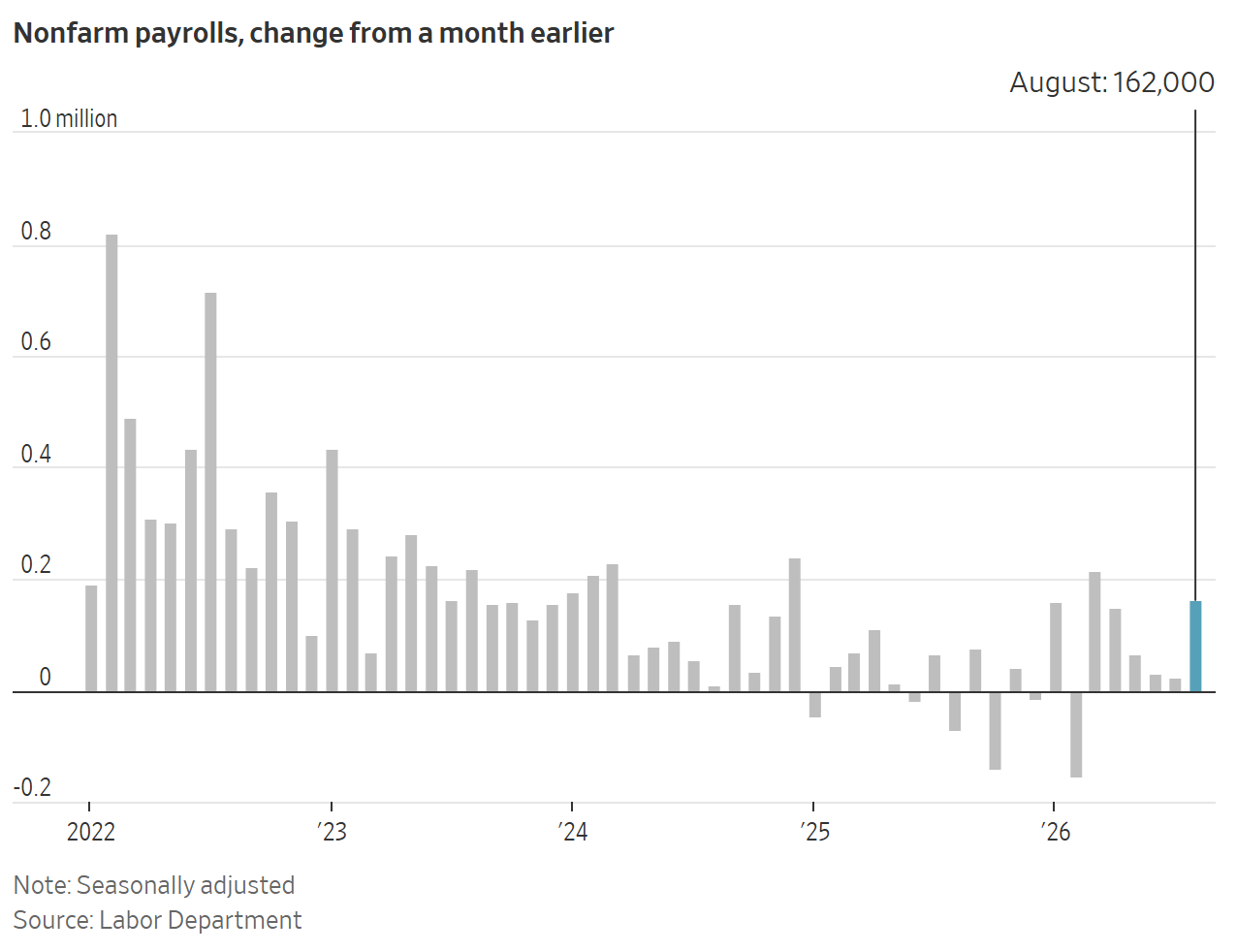
August NFP exceeded expectations. Nonfarm payrolls increased by 162,000 in August, above the consensus forecast of 55,000. July payrolls were revised up to 21,000 from an initially reported decline of 23,000, while June payrolls were revised to 31,000 from 20,000. As a result, job gains for June and July were 55,000 higher than previously reported, lifting the 3-month average to 71,000 from the prior estimate of 20,000.
The unemployment rate held at 4.1%, in line with expectations, while the participation rate rose to 61.6% from 61.4%. Average hourly earnings increased 0.3% m/o/m, matching consensus, and were up 3.1% y/o/y. Private payrolls rose by 127,000, with leisure and hospitality contributing 62,000 jobs and education and health services adding 29,000, while information, down 23,000, and financial activities, down 11,000, were the largest drags. Government payrolls increased by 35,000, partially reversing July’s 50,000 decline. Despite the stronger employment report, inflation remains the key swing factor for this month’s Fed rate decision, putting primary focus on next week’s CPI release.
US Stock Indices
Dow Jones Industrial Average -0.51%
Nasdaq 100 +0.21%
S&P 500 -0.38%, with 8 of the 11 sectors of the S&P 500 down
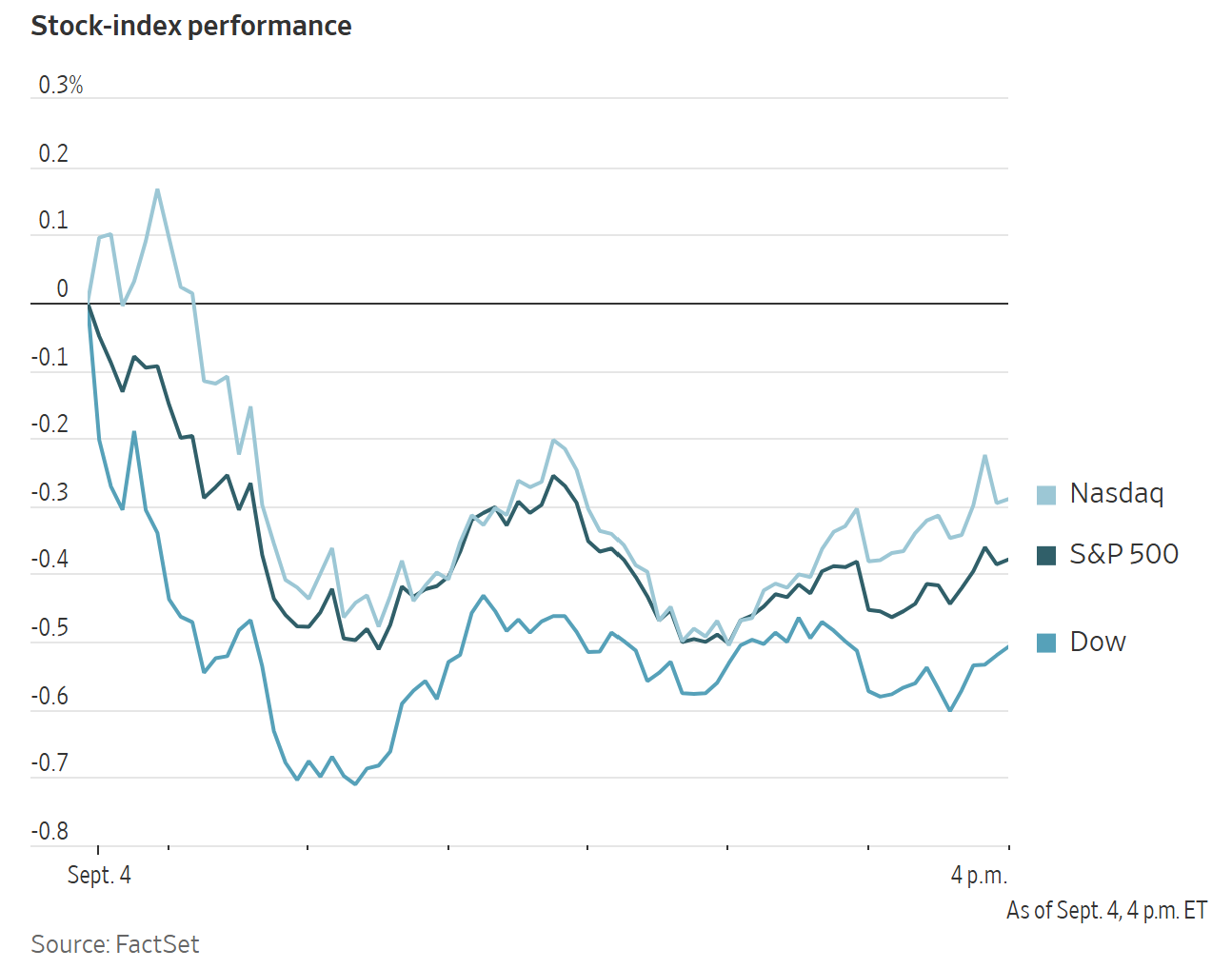
A stronger-than-expected US employment report weighed on equities and short-term bond prices on Friday, as traders increased expectations that the Fed could raise rates later this month.
The Dow Jones Industrial Average led the decline, falling -0.51%, or 271.85 points. The S&P 500 slipped -0.38%, while the Nasdaq Composite retreated -0.29%.
For the week, US indices were mixed. The S&P 500 advanced +0.42%, the Dow Jones declined -0.27%, and the Nasdaq Composite gained +0.40%.
In corporate developments, DeepSeek plans to deploy at least 160,000 of Huawei’s most advanced accelerators at a large data centre under construction in Inner Mongolia. The project could create one of the largest known clusters of Huawei AI chips and further support China’s push to reduce reliance on Nvidia technology.
Bloomberg news reported that Moonshot AI is considering raising up to $5 billion through a planned Hong Kong IPO as early as this year, according to people familiar with the matter, as the Chinese AI company seeks to capitalise on strong investor demand.
Volkswagen’s approved turnaround agreement, announced Thursday, outlined plans to cut 50,000 jobs by 2030 and invest €135 billion between 2027 and 2031. It is also targeting a 9.0% operating margin, equivalent to approximately €31 billion in profit, compared with 3.8% in the first half of this year. The company said competitive output cannot be assured at its German plants in Emden, Zwickau, Hanover and Neckarsulm. It is reviewing alternatives for those sites while simplifying its group structure. The restructuring plan reflects weaker market share and demand in China, elevated labour and manufacturing costs, excess capacity, US tariffs and stronger Asian competition. Volkswagen added that its supervisory board recognises that European capacity currently exceeds demand by more than 500,000 units.
European Stock Indices
CAC 40 -0.09%
DAX +0.17%
FTSE 100 -0.00%
Commodities
Gold spot -1.01% to $4,427.69 an ounce
Silver spot -1.14% to $66.19 an ounce
West Texas Intermediate -0.49% to $91.22 a barrel
Brent crude +0.05% to $95.85 a barrel
Gold fell on Friday, ending the week in negative territory.
Spot gold declined -1.01% to $4,427.69 per ounce, leaving it down -0.56% for the week.
Spot silver fell -1.14% to $66.19 per ounce. It was down -0.25% on the week.
Oil prices were mixed on Friday. Both benchmarks closed the week higher as US - Iran kinetic activity resumed in the seventh month of the conflict. US retail diesel prices reached a record high.
Brent crude futures settled at $95.85 per barrel, up 5 cents, or +0.05%. WTI crude futures closed at $91.22 per barrel, down 45 cents, or -0.49%.
For the week, Brent crude rose +7.25%, while US WTI gained +9.32%.
The oil rally has pushed inflation and government borrowing costs higher globally, intensifying concerns that economic growth could weaken without relief.
Average US diesel prices reached record highs as renewed US - Iran hostilities and Ukrainian attacks on Russian refineries deepened supply disruptions. Diesel now costs an average of $5.85 per gallon in the US, according to AAA data.
Diesel prices could rise further amid sharp inventory drawdowns and as agricultural states enter harvesting and planting seasons. Diesel remains a key fuel for agricultural equipment. Its equivalent futures contract, heating oil, has also surged as winter approaches.
The US government has said Middle Eastern oil flows have returned to near-normal levels in recent weeks, although analysts and tanker trackers suggest flows remain materially disrupted.
Only four commodity vessels transited the Strait of Hormuz on Thursday, well below the 10-day average of about 15, preliminary shipping data showed.
Iraq increased its August oil exports to about 2.34 million bpd, from roughly 1.35 million bpd in July, two Iraqi energy officials said last Wednesday.
Note: As of 4 pm EDT 4 September 2026
Currencies
EUR -0.19% to $1.1603
GBP -0.05% to $1.3513
Bitcoin -2.37% to $79,670.64
Ethereum -2.31% to $2,453.53
The US dollar advanced on Friday after data showed that US employers added 162,000 jobs in August, well above expectations for a 56,000 increase.
However, the dollar pared some of its initial gains as US markets headed into a three-day Labor Day weekend and traders awaited this week’s inflation data.
The dollar index rose +0.16% to 99.16, while the euro fell -0.19% to $1.1603. Despite Friday’s advance, the US dollar index declined -0.52% last week, while the euro appreciated +0.16%.
Against the Japanese yen, the US dollar retreated -0.25% to ¥156.24.
The yen strengthened over the week as traders increased bets on additional or faster BoJ interest rate hikes. It is testing the ¥155.21 level, reached after last month’s Washington - Tokyo intervention; a break below that threshold would mark its strongest level since 6 May. The yen rose +2.37% against the US dollar last week.
The British pound slipped -0.05% to $1.3513 on Friday, bringing its weekly loss to -0.16%. BoE Chief Economist Huw Pill said on Thursday that raising interest rates now would help reduce the risk that the central bank must act more aggressively later to contain inflation, which has risen as a result of the Iran war.
Money markets indicate that traders expect the BoE to raise rates twice over the next six months. Economists expect the central bank to leave rates unchanged later this month as it monitors corporate pricing power and wage growth against a backdrop of elevated energy prices.
Fixed Income
US 10-year Treasury +1.6 basis points to 4.789%
German 10-year Bund -0.5 basis points to 3.354%
UK 10-year Gilt -0.5 basis points to 5.060%
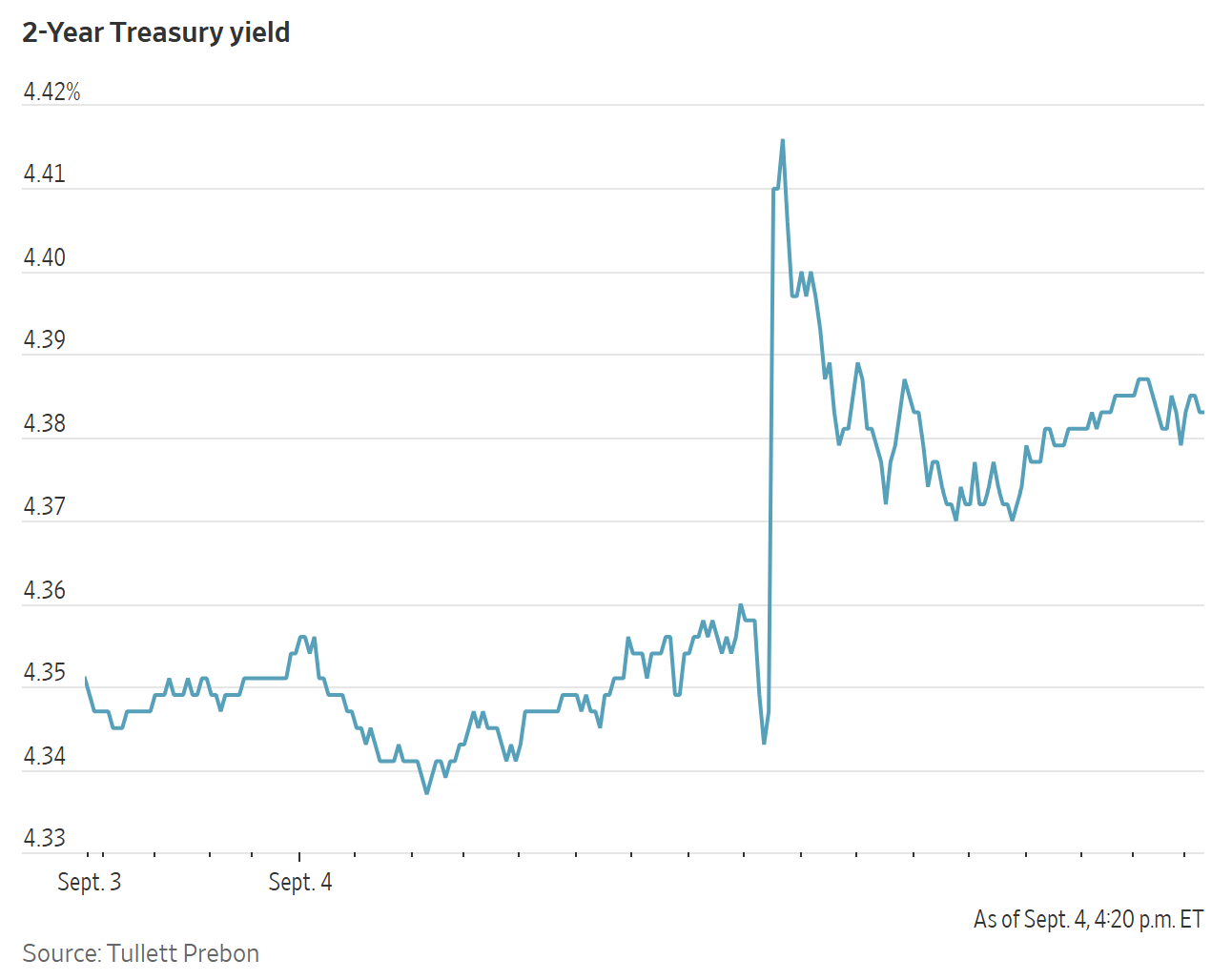
The US yield curve bear-flattened on Friday after a stronger-than-expected employment report prompted investors to increase bets on tighter Fed policy. Yields eased from their highs as market participants positioned for this week’s inflation data.
Markets were pricing a 59.4% probability of a hike on Friday, up from 57.0% in the prior week, according to CME FedWatch.
The two-year yield, which is particularly sensitive to monetary policy expectations, rose +2.1 bps to 4.372%. The initial bond selloff pushed the yield to a peak of 4.425%, its highest level since January 2025. The move left the 2-year yield higher on the week by +2.0 bps.
Cleveland Fed President Beth Hammack reiterated in a Friday LinkedIn post that interest rates need to rise to address inflation levels she described as ‘too high.’
The 10-year Treasury yield rose +1.6 bps to 4.789% after reaching 4.812% following the data. For the week, the 10-year yield advanced +7.2 bps.
The 30-year Treasury yield declined by -0.4 bps to 5.247%. However, over the week, the 30-year yield rose +4.0 bps.
The US 2s10s yield curve stood at 41.7 bps, 5.2 bps wider than the 36.5 bps recorded the prior week.
Across the Atlantic, eurozone bond yields edged lower on Friday but posted a fourth consecutive weekly increase.
Germany’s 10-year Bund yield declined -0.5 bps to 3.354%. For the week, the yield rose +5.8 bps after reaching its highest level since 2011.
Germany’s 2-year bond yield, which is sensitive to ECB deposit-rate expectations, declined -1.7 bps to 2.951%. However, throughout the week it traded +4.6 bps higher.
Traders were pricing in 47 bps of additional ECB tightening this year, down from more than 50 bps on Wednesday, but above 44 bps a week earlier.
France’s 10-year OAT yield declined -0.2 bps on Friday. but rose +9.0 bps over the week. The spread between French 10-year OAT yields and Bunds stood at 85.3 bps after reaching 90 bps earlier in the week, its widest level since November 2024, as investors focussed on a difficult annual budget debate in the coming months. The spread widened by 3.2 bps over the week.
Italy’s 10-year BTP yield declined -1.9 bps on Friday to 4.151%, but rose +5.5 bps over the week. The spread over Bunds stood at 79.7 bps, 0.3 bps narrower than the prior week.
Note: As of 4 pm EDT 4 September 2026
While every effort has been made to verify the accuracy of this information, EXT Ltd. (hereafter known as “EXANTE”) cannot accept any responsibility or liability for reliance by any person on this publication or any of the information, opinions, or conclusions contained in this publication. The findings and views expressed in this publication do not necessarily reflect the views of EXANTE. Any action taken upon the information contained in this publication is strictly at your own risk. EXANTE will not be liable for any loss or damage in connection with this publication.Ф
This article is provided to you for informational purposes only and should not be regarded as an offer or solicitation of an offer to buy or sell any investments or related services that may be referenced here. Trading financial instruments involves significant risk of loss and may not be suitable for all investors. Past performance is not a reliable indicator of future performance.








Created by professionals. For professionals.
