

Is growth becoming a duration problem?


 S&P 500 -0.75% to 7,706.03 US 10-year yield +14.6 basis points to 5.116% Spot gold -1.56% to $4,286.02 an ounce DXY +0.58% at 101.13
Key data to move markets today
EU: German IFO Business Climate, Current Assessment and Expectations and speeches by ECB’s Chief Economist Philip Lane and Executive Board member Isabel Schnabel
UK: GfK Consumer Confidence and speeches by BoE Deputy Governors Sarah Breeden and Clare Lombardelli and MPC external member Swati Dhingra
USA: Initial and Continuing Jobless Claims, New Home Sales, Kansas Fed Manufacturing Activity and speeches by New York Fed President John Williams, Cleveland Fed President Beth Hammack and Philadelphia Fed Governor Anna Paulson
CHINA: Markets closed due to Mid-Autumn Festival
Global Macro Updates
PMIs turn up the heat. September’s flash PMIs presented bond markets with an uncomfortable combination of stronger than expected activity, firmer demand and renewed cost pressures. This mix became a catalyst for Tuesday’s global selloff by challenging expectations for inflation to normalise and reinforcing the risk that resilient growth, energy driven inflation and tighter capacity could, quite likely, keep interest rates elevated for longer.
The US delivered the clearest hawkish shock. The S&P Global Flash Composite PMI rose to 58.4 from 56.0, its strongest reading since July 2021 and its fourth consecutive acceleration. The Flash Manufacturing PMI increased to 57.0, while the Flash Services PMI advanced to 58.7 as output expanded at its fastest pace in more than five years. New orders, backlogs and hiring also strengthened. Input cost inflation reached its highest level since October 2022, driven by fuel, transportation and rising wage costs. This combination prompted a sharp repricing of Fed expectations and pushed the 10-year Treasury yield above 5%.
The eurozone reinforced the bearish momentum. Its S&P Flash Composite PMI unexpectedly rose to 53.1, the highest level in more than three years, as services rebounded and both Germany and France returned to expansion. New orders strengthened, backlogs accumulated and demand related to AI and defence supported manufacturing. At the same time, higher fuel and energy costs pushed price pressures to their steepest level since May, signalling stronger growth alongside persistent inflation. S&P Global’s estimate of approximately 0.4% quarterly GDP growth in Q3 and improving order books point to continued momentum in Q4, although weak confidence in France leaves some scope for a downward revision in the final reading.
The UK diverged on growth, but not on inflation. The S&P Global Flash Composite PMI eased to 51.7 as services moderated, while manufacturing improved to 52.0, its highest level in three months. Consumer demand and hiring remained weak despite support from technology, AI and defence spending. At the same time, input costs accelerated for a second consecutive month, reflecting higher energy, fuel and raw material expenses. Prices charged also rose at a faster pace, suggesting renewed upward pressure on consumer inflation.
US Stock Indices
Dow Jones Industrial Average -0.68%
Nasdaq 100 -0.85%
S&P 500 -0.75%, with 10 of the 11 sectors of the S&P 500 down
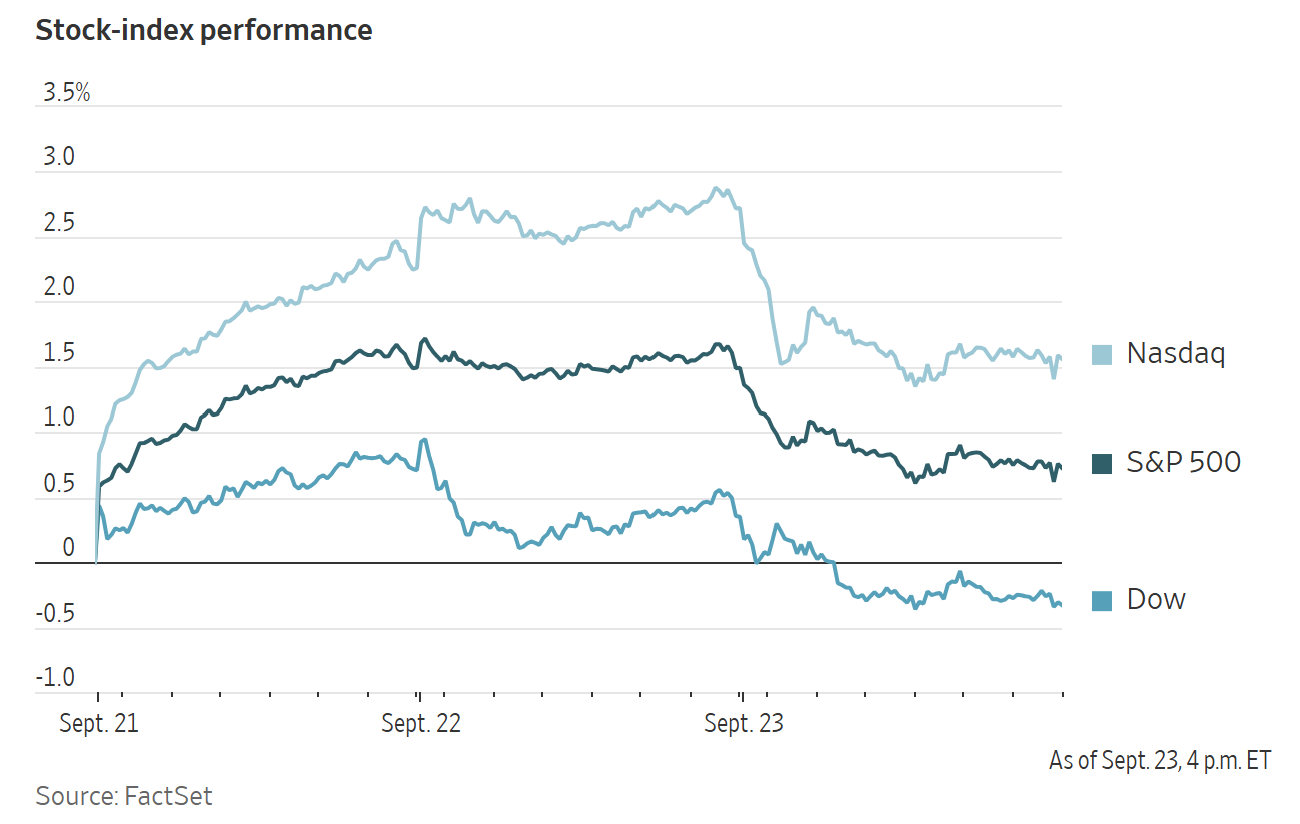
US equities declined alongside bonds as rising oil prices intensified inflation concerns, reinforced by data showing US business activity expanded at its fastest pace since 2021.
The S&P 500 fell -0.75%, the Nasdaq Composite declined -1.13% and the Dow industrials lost -0.68%, or 352.10 points.
In corporate news, The Wall Street Journal reported that activist hedge fund Jana Partners is pressing Six Flags Entertainment to consider a sale, according to people familiar with the matter. On Tuesday, Jana urged the theme park operator’s board to immediately retain an investment bank after expressing disappointment with the company’s second quarter results.
McDonald’s is allocating about $8.5 billion through 2036 to help franchisees carry out a multiyear plan to improve food, service and restaurant operations. The funding will support restaurant modernisation, technology upgrades and other improvements announced earlier this year. Franchisees are expected to spend more than $1 million per location on average, with the company’s assistance covering part of the cost.
Walt Disney is raising prices on several US streaming plans for the sixth time in six years. The ad free Disney+ subscription will increase by $2.50 to $21.49 per month, while the ad free Disney+ and Hulu bundle will rise by $2 to $21.99. Standalone Disney+ and Hulu plans with ads will each cost $12.49 per month, up 50 cents.
European Stock Indices
CAC 40 -0.39%
DAX -0.66%
FTSE 100 -0.03%
Commodities
Gold spot -1.56% to $4,286.02 an ounce
Silver spot -3.42% to $64.78 an ounce
West Texas Intermediate +2.42% to $92.71 a barrel
Brent crude +4.90% to $103.44 a barrel
Gold prices fell to a near one-week low on Wednesday, as the US dollar climbed to a two-month high and weighed on non-yielding bullion.
Spot gold declined -1.56% to $4,286.02 per ounce, after touching its lowest level since 17 September earlier in the session.
Spot silver fell -3.42% to $64.78 per ounce.
Oil prices settled higher on Wednesday after a volatile session, as traders assessed Iranian President Masoud Pezeshkian’s pledge never to surrender, one day after the US president warned that Iran could be annihilated.
Brent crude futures settled $4.83 higher, or +4.90%, at $103.44 per barrel. WTI futures gained $2.19, or +2.42%, to $92.71 per barrel.
Crude benchmarks snapped a five-day losing streak as prospects for a potential US - Iran agreement at the UN General Assembly appeared to fade, outweighing reports that crude loadings at Saudi Arabia’s Yanbu port were resuming.
Late in the morning, Iran’s security chief said Tehran would not return to the pre-Islamabad Memorandum of Understanding (MoU) arrangement, reiterating that Washington must comply with Tehran’s seven conditions or the Strait of Hormuz would remain closed. He added that Iran was in no hurry to negotiate.
Iran’s president told the UN that the country would never surrender to the US, while maintaining that it still believed in diplomacy.
Additionally, Libya’s National Oil Corporation said production at the Sharara oil field, which has a capacity of more than 300,000 bpd, had fallen below 100,000 bpd.
Bloomberg news, citing satellite imagery, reported that Saudi Arabia had resumed oil loadings at its Yanbu South terminal on the Red Sea. Reuters also reported that Saudi Arabia restarted operations on its East - West Pipeline to the Red Sea on Tuesday, citing three sources briefed on the matter.
On the same day, Reuters reported that Saudi Aramco offered additional barrels to Asian refiners through ship-to-ship transfers outside the Strait of Hormuz.
Additionally, Asian imports are approaching their highest level since the war began. Kpler, as reported by Reuters, estimated that Asian crude imports in September were tracking toward their highest monthly average since the start of the war, at 23.96 million bpd.
The US DOE’s Weekly Petroleum Status Report showed a 2.970 million-barrel build in crude inventories, a 2.2 million-barrel build at Cushing, a 1.690 million-barrel draw in gasoline stocks and a 428,000-barrel draw in distillate inventories. Refinery utilisation fell 2.8 percentage points to 94.0%. Canadian crude imports declined by 1.1 million bpd to their lowest level since December. The crude build was concentrated in PADD 2, where inventories increased by 4.4 million barrels as refinery utilisation fell 11.0 percentage points to 89.0% and refinery crude inputs declined by 439,000 bpd. Gasoline and distillate inventories also increased in PADD 2.
Iraq’s oil minister said on Tuesday that the country was exporting more than 3 million bpd and expected to increase exports through Turkey to more than 600,000 bpd.
Note: As of 4 pm EDT 23 September 2026
Currencies
EUR -0.56% to $1.1383
GBP -0.78% to $1.3283
Bitcoin -2.16% to $84,378.46
Ethereum -2.72% to $2,674.53
The US dollar rallied to its highest level in nearly two months on Wednesday.
The dollar index rose +0.58% to 101.13 after reaching 101.23 earlier in the session, its highest level since 29 July.
The euro declined -0.56% to $1.1383, marking its third consecutive daily loss and its steepest decline in a week.
The Japanese yen weakened -0.63% against the US dollar to ¥158.31 per dollar. Traders remained alert to possible intervention after the BoJ’s rate increase to a 31-year high failed to reassure investors that further tightening would follow.
Analysts noted that the closure of Japanese markets for a holiday reduced liquidity and increased the likelihood of official intervention.
The British pound fell -0.78% to $1.3238.
Fixed Income
US 10-year Treasury +14.6 basis points to 5.116%
German 10-year Bund +9.3 basis points to 3.562%
UK 10-year Gilt +10.8 basis points to 5.350%
The selloff in the US bond market had remained largely orderly in recent weeks. That changed on Wednesday.
In the morning, a typically uneventful business-activity survey jolted the market by signalling unexpectedly resilient growth and persistent inflationary pressures. Selling then intensified as the day progressed, driven by forceful remarks from an Iranian official at the UN, hawkish comments from a Fed governor and weak demand at a government bond auction.
Traders awaited the Treasury Department’s announcement of the size of its bond-buyback operation scheduled for today. The announced amount of $6 billion had little effect on the selloff.
Together, these developments created a perfect storm that produced the largest one-day increase in the 10-year Treasury yield since President Trump’s Liberation Day tariff announcement unsettled markets in April 2025. The 10-year yield closed at 5.116%, surpassing recent highs and reaching a level not seen since 2007.
Overall, it was the worst session for US government bonds in nearly 18 months.
On Wednesday, Fed Governor Michael Barr said the FOMC had taken an important step the previous week to recalibrate short-term borrowing costs and curb inflation, adding that further interest-rate increases would likely be necessary.
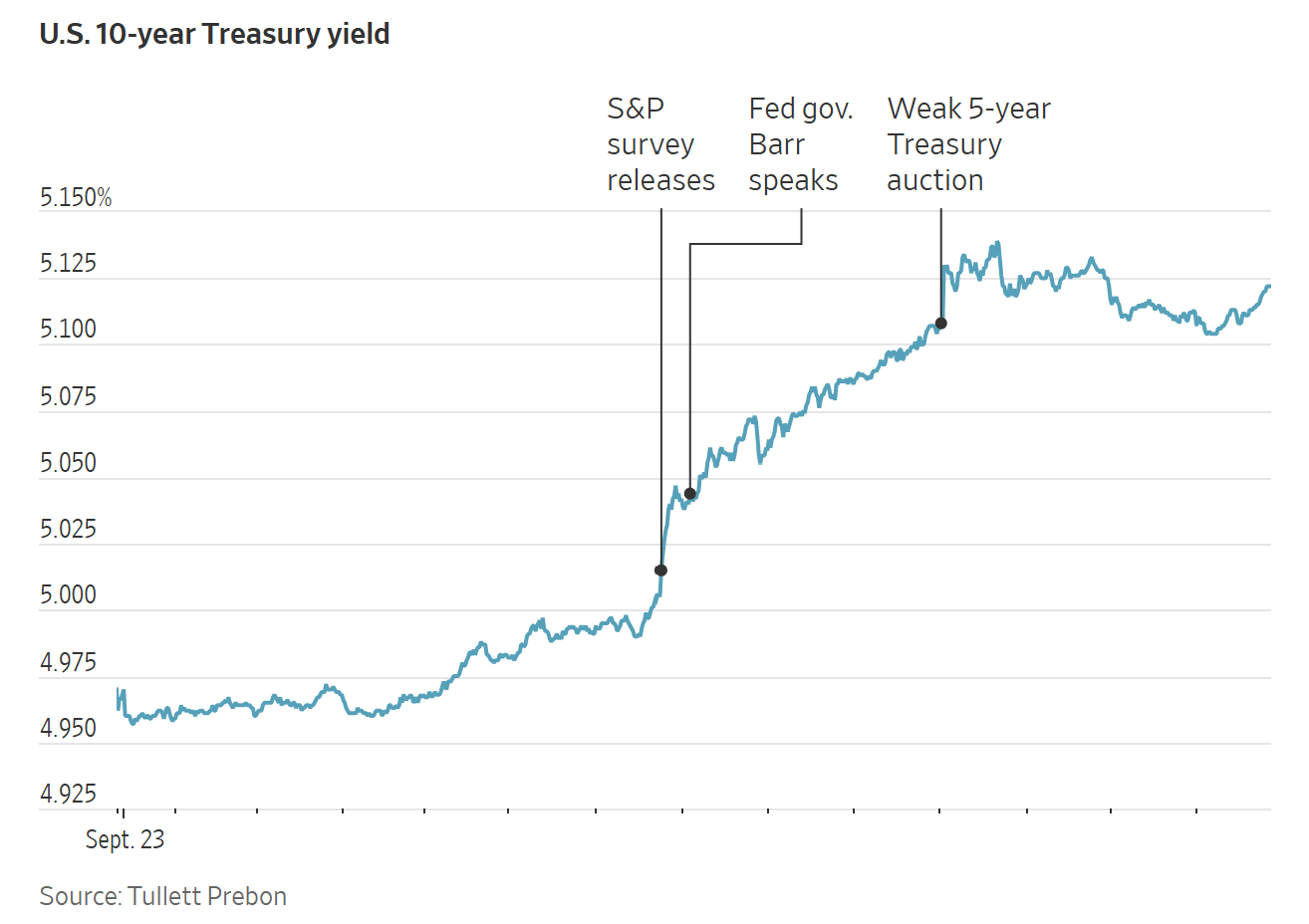
The two-year US Treasury yield rose +15.2 bps to 4.903%. The 10-year yield increased +14.6 bps to 5.116%, while the 30-year yield advanced +9.9 bps to 5.402%.
The US 2s10s yield curve stood at 21.3 bps, 0.6 bps narrower than on Tuesday.
Money markets assigned a 69.7% probability to a 25-bps increase at the Fed’s 28 October meeting, up from 55.4% on Tuesday, according to CME FedWatch.
Eurozone government bonds also sold off on Wednesday.
The yield on Germany’s 10-year Bund rose +9.3 bps to 3.562%. The yield on Germany’s two-year Schatz, which is sensitive to expectations for the ECB deposit rate, rose +10.5 bps to 3.341%.
The selloff was more pronounced elsewhere in the bloc. France’s 10-year yield rose +13.7 bps to 4.644%, its highest level since 2008. The spread between French and German 10-year yields widened to 108.2 bps.
Italy’s 10-year BTP yield increased +14.2 bps to 4.492%, leaving its spread over Bunds at 93.0 bps.
France has faced heightened scrutiny in recent weeks as it approaches the 2027 election cycle and contends with budgetary risks arising from a fragmented parliament.
Bundesbank President Joachim Nagel said late Tuesday that oil prices were becoming an increasingly important consideration for ECB policymakers when setting interest rates. He also left open the possibility of further rate increases, noting that core inflation remained too high, although he had not yet observed significant second-round inflation effects.
On Tuesday traders were pricing in approximately 35 bps of additional ECB tightening this year, slightly more than before Wednesday’s PMI release, but below the roughly 40 bps priced on Friday.
Note: As of 4 pm EDT 23 September 2026
While every effort has been made to verify the accuracy of this information, EXT Ltd. (hereafter known as “EXANTE”) cannot accept any responsibility or liability for reliance by any person on this publication or any of the information, opinions, or conclusions contained in this publication. The findings and views expressed in this publication do not necessarily reflect the views of EXANTE. Any action taken upon the information contained in this publication is strictly at your own risk. EXANTE will not be liable for any loss or damage in connection with this publication.
This article is provided to you for informational purposes only and should not be regarded as an offer or solicitation of an offer to buy or sell any investments or related services that may be referenced here. Trading financial instruments involves significant risk of loss and may not be suitable for all investors. Past performance is not a reliable indicator of future performance.
 Back to all insights








Created by professionals. For professionals.
