

Is US growth outrunning hiring?


 S&P 500 +1.06% to 7,747.71 US 10-year yield -1.1 basis points to 4.773% Spot gold +1.94% to $4,472.86 an ounce DXY -0.56% to 99.00
Key data to move markets today
EU: German Factory Orders, Eurozone’s Retail Sales and a speech by ECB’s Chief Economist Philip Lane
UK: A speech by BoE Governor Andrew Bailey
USA: Nonfarm Payrolls, Average Hourly Earnings, Labor Force Participation Rate, U6 Underemployment Rate and Unemployment Rate
Global Macro Updates
August NFP preview. The August nonfarm payrolls report is scheduled for release by the US Bureau of Labor Statistics at 8:30 am ET today. Consensus expectations point to headline job growth of approximately 55,000, following July’s 23,000 decline, which marked the first negative reading since February.
Preview commentary broadly highlights the potential for seasonal softness and possible downward revisions to June and July payrolls. Attention is expected to centre on the unemployment rate, which is forecast to hold at 4.1%, although analysts have flagged some upside risk if the recent downward trend in labour-force participation reverses.
Even so, a modest increase to 4.2% could still be viewed as benign from a monetary-policy perspective. Average hourly earnings are expected to rebound to a 0.3% m/o/m pace after July’s soft 0.1% m/o/m increase, which was 0.053% on an unrounded basis and the weakest reading year to date.
August ISM Services. The August ISM Services index rose to 55.4, above consensus expectations of 54.3 and July’s 54.1 reading. New orders increased by 3.7 points to 60.9, the strongest level since February 2023, while business activity advanced by 2.6 points m/o/m to 61.7, the highest level since November 2022.
Employment remained the main area of softness, edging up by 0.4 points to 47.8 but staying in contraction for a second consecutive month; however, slightly fewer companies reported staff reductions than in July. The prices index rose by 2.3 points to 72.6, its highest level since August 2022, with fuel prices increasing for a seventh consecutive month. Report commentary cited tariffs and the Middle East conflict as the most frequently mentioned supply-chain pressures, alongside favourable summer seasonality.
US Stock Indices
Dow Jones Industrial Average +1.18%
Nasdaq 100 +1.16%
S&P 500 +1.06%, with 8 of the 11 sectors of the S&P 500 up
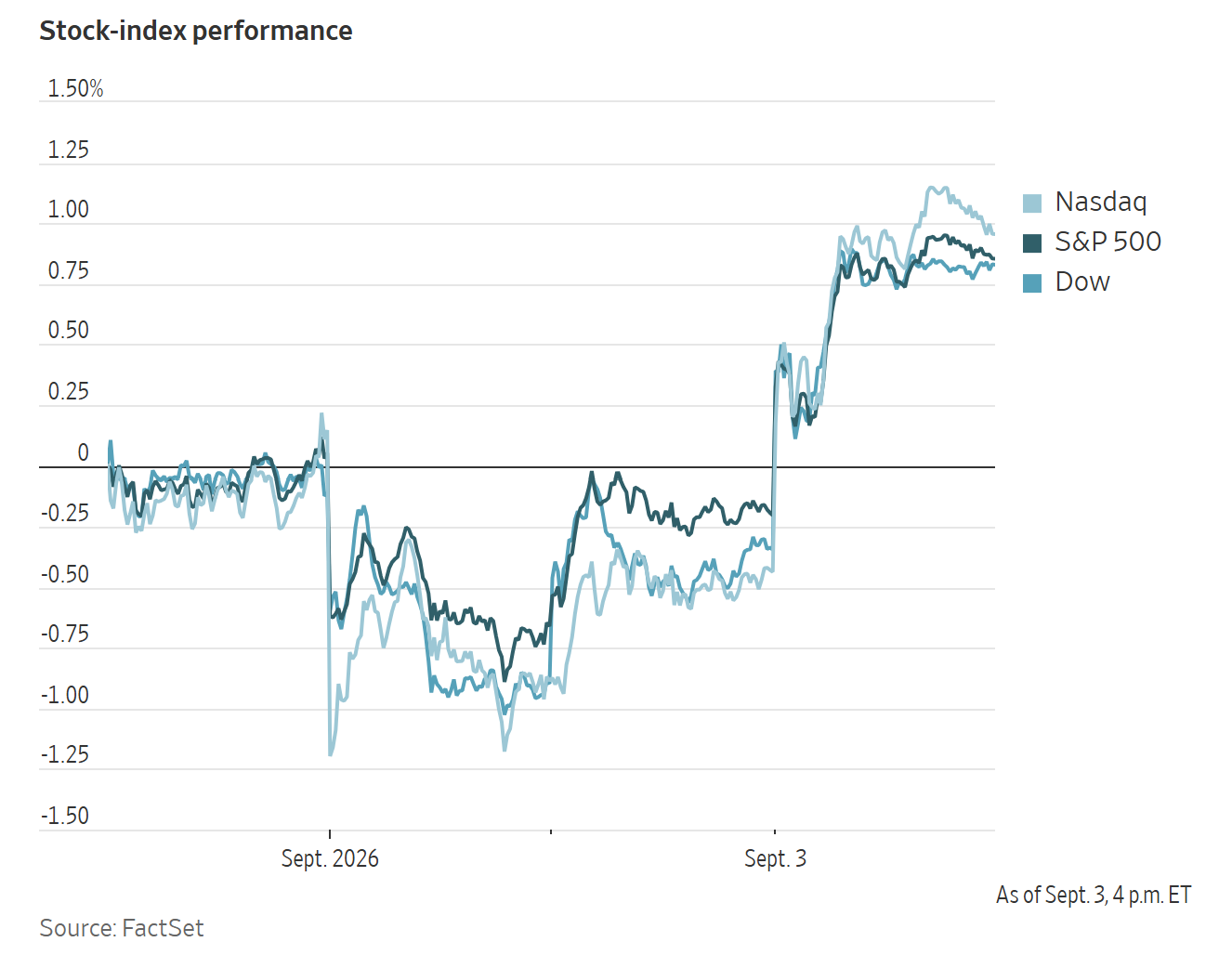
US equities rallied on Thursday in a broad-based advance, with eight of the S&P 500’s 11 sectors closing higher. Consumer discretionary led sector gains, rising +1.58%, while the S&P 500 advanced +1.06%. The Dow industrials added 624.16 points, or +1.18%, and technology shares outperformed, lifting the Nasdaq Composite +1.40%.
In corporate news, Tesla is preparing to reintroduce its Cybercab robotaxi at an upcoming launch event in Austin.
Adobe appointed Anil Chakravarthy, president of its customer experience business, as its next CEO. The move places a long-serving company executive at the helm as Adobe seeks to defend its market leadership amid intensifying competition from AI-focussed challengers.
Nvidia agreed to acquire startup Hugging Face in a transaction valued at approximately $13 billion, adding a widely used software platform to its expanding AI ecosystem. The agreement includes an equity-based retention programme of up to $1 billion for Hugging Face employees who join Nvidia, while Nvidia said it would keep the platform open. Founded in 2016, Hugging Face was valued at $4.5 billion in a funding round three years ago.
Separately, Blackstone Private Credit Fund, the largest private-credit vehicle marketed to individual investors, received redemption requests totalling $4.3 billion in its latest quarter, equal to roughly 10% of shares outstanding.
The fund limited payouts to 5% of its value, in line with the redemption cap required for semi-liquid funds. It also recorded another quarter of net outflows, equivalent to about 3% of net asset value.
This marked the third consecutive quarter in which redemption requests at the fund, known as BCRED, exceeded the 5% threshold and the second straight quarter in which redemptions were capped. In March, the fund fulfilled all requests despite demand exceeding that threshold.
European Stock Indices
CAC 40 +0.07%
DAX +0.63%
FTSE 100 +0.70%
Commodities
Gold spot +1.94% to $4,472.86 an ounce
Silver spot +3.05% to $66.95 an ounce
West Texas Intermediate +1.15% to $91.67 a barrel
Brent crude +0.59% to $95.80 a barrel
Gold advanced by more than one percent on Thursday, supported by renewed demand for precious metals.
Spot gold rose +1.94% to $4,472.86 per ounce after earlier touching its highest level since 28 August.
Spot silver also strengthened, gaining +3.05% to $66.95 per ounce.
Oil prices settled higher on Thursday as renewed geopolitical risks in the Middle East supported supply-risk premia, although gains were moderated by comments from Russian President Vladimir Putin suggesting openness to peace negotiations.
Brent crude futures settled $0.56, or +0.59%, at $95.80 per barrel, while US WTI rose $1.04, or +1.15%, to $91.67. Both contracts had earlier reached six-week highs.
Prices were initially supported by reports that Iran had launched attacks toward Kuwait and the UAE, alongside remarks from the US President indicating that any renewed attacks on Iran would likely be short-lived. Later in the session, prices eased after Putin stated that there was a possibility of reaching an agreement to end the war in Ukraine, adding that several countries, including the US and China, were prepared to support a peace settlement.
Saudi Aramco kept the October official selling price for Arab Light to Asia unchanged m/o/m at a discount of $2.00 per barrel relative to the Oman/Dubai average benchmark.
Iraq’s crude exports reached six-month highs after SOMO reported shipments of 73 million barrels last month, the strongest level since the war in Iran began. Export strength was supported by Iran issuing permits for passage through the Strait of Hormuz and by Iraq’s earlier decision to offer steep discounts to buyers willing to load crude at the Al Basrah terminal.
Putin’s comments also helped ease concerns over Russian fuel-supply disruptions, as a de-escalation in attacks on refineries could allow production to normalise, adding downward pressure to prices during the session.
Speaking at an economic forum in Russia’s Far East, Putin said there was a chance of reaching an agreement to end the war in Ukraine and noted that several countries, including the US and China, were ready to support a peace settlement.
Preliminary shipping data showed that six commodity vessels transited the Strait of Hormuz on Wednesday, down from 11 the previous day and below the 10-day average of approximately 13.
Separately, Iran added vessels to the list of ships it considers non-compliant and subject to fines, confiscation or detention if they attempt to sail through the strait.
Note: As of 4 pm EDT 3 September 2026
Currencies
EUR +0.34% to $1.1625
GBP +0.30% to $1.3520
Bitcoin +5.57% to $81,606.03
Ethereum +5.08% to $2,511.57
The yen strengthened by more than one percent against the US dollar on Thursday as traders increased wagers on a BoJ rate hike, while analysts noted that BoJ data showed no evidence of official intervention behind Wednesday’s sharp currency gains.
The yen’s abrupt appreciation against the dollar on Wednesday had fuelled speculation that Japanese authorities intervened to support the currency, particularly as gains from the historic US - Japan action in late July had begun to fade.
However, in the absence of evidence of official action, analysts said the move instead reflected expectations that the BoJ could raise rates by more than previously anticipated at its 17 - 18 September meeting.
BoJ daily account data released Thursday indicated there was no USD selling or yen buying by the MoF on Wednesday. Market participants also reported no MoF rate checks on the day.
During a rate check, a government or central bank asks financial institutions to quote an exchange rate but does not buy or sell.
Japan's top currency diplomat Atsushi Mimura said on Thursday that he remained on alert over currency market developments, warning that he was not yet comfortable with recent moves in the yen.
Hawkish comments from BoJ board member Hajime Takata were cited as a factor behind yen strength. Takata said on Wednesday the central bank should conduct interest rate hikes nimbly to counter intensifying inflationary pressures, rather than adhere to a fixed semiannual pace anticipated by markets.
Markets are now pricing a 75% probability of a 25 bps BoJ rate hike this month, with some traders speculating that a larger move remains possible. An additional October hike is also viewed as possible, though not the base case.
The Japanese yen was +1.78% on the day at ¥155.85 per dollar, approaching the ¥155.21 level reached after the July intervention. A move beyond that level would mark its strongest level since 6 May.
The Japanese currency has struggled to find fundamental support, coming under pressure from still-wide interest rate differentials, fiscal worries and a renewed spike in energy prices.
The dollar added to losses as traders pared bets on a September rate hike.
The dollar index fell -0.56% to 99.00, while the euro rose +0.34% to $1.1625 and sterling gained +0.30% to $1.3520.
Consumer and producer price inflation reports for August are due next week. Data on Thursday showed that the number of Americans filing claims for unemployment benefits increased marginally last week, suggesting no material shift in labour market conditions at the end of August.
Fixed Income
US 10-year Treasury -1.1 basis points to 4.773%
German 10-year Bund +2.0 basis points to 3.359%
UK 10-year Gilt -9.6 basis points to 5.065%
US Treasury yields declined across the curve on Thursday after remarks from Fed Governor Christopher Waller reduced expectations that the FOMC would raise interest rates at its next policy meeting.
In prepared remarks at a Reuters NEXT Newsmaker event in Washington, Waller said that if upcoming data confirm inflationary pressures are cooling, he would be inclined to support keeping interest rates unchanged at the Fed’s next meeting.
In addition, Waller said he's inclined to be patient on rate policy while watching to see if price pressures ease.
Following the comments, expectations for a Fed hike at the 15 - 16 September meeting declined, with markets pricing a 50.2% probability of a hike, down from 63.2% in the prior session, according to CME FedWatch.
The yield on the US 10-year Treasury note fell -1.1 bps to 4.773%. On Wednesday, the yield reached 4.818%, its highest level since 1 November 2023.
The yield on the 30-year bond declined -0.9 bps to 5.260%.
The US 2s10s yield curve was at a positive 42.2 bps.
The two-year US Treasury yield, which typically tracks Fed funds rate expectations, fell -3.7 bps to 4.351%, marking its largest decline since 13 August.
Eurozone government bonds snapped a six-day losing streak on Thursday, pulling yields back from multi-year highs.
Germany’s 10-year Bund yield declined -2.0 bps to 3.359%, just below the 15-year high of 3.395% reached on Wednesday.
Rising energy prices have prompted traders to increase expectations for tighter policy from global central banks, including the ECB. Money markets are fully pricing a 25 bps rate hike to 2.5% from the ECB at next week’s policy announcement and have moved close to fully pricing a 3.00% deposit rate by June next year, implying two additional hikes by mid-2027.
The backdrop for tighter policy has weighed on sovereign bonds across the euro zone, with yields touching multi-year highs not just in Germany but in France, Italy and Spain, among others.
Germany’s two-year yield, which is sensitive to changes in ECB deposit-rate expectations, declined -3.9 bps to 2.968% on Thursday after reaching 3.012% on Wednesday, its highest level in more than two years.
Germany’s 30-year bond yield fell -2.0 bps to 3.817% on Thursday after touching 3.861% on Wednesday, its highest level since April 2011.
Italy’s 10-year BTP continued to trade at a lower premium versus Bunds than France’s 10-year OAT. Both 10-year yields declined -4.4 bps on Thursday, leaving Italy’s 10-year BTP premium over Bunds at 81.1 bps and the French OAT premium at 85.0 bps.
Note: As of 4 pm EDT 3 September 2026
While every effort has been made to verify the accuracy of this information, EXT Ltd. (hereafter known as “EXANTE”) cannot accept any responsibility or liability for reliance by any person on this publication or any of the information, opinions, or conclusions contained in this publication. The findings and views expressed in this publication do not necessarily reflect the views of EXANTE. Any action taken upon the information contained in this publication is strictly at your own risk. EXANTE will not be liable for any loss or damage in connection with this publication.
هذه المقالة متاحة لأغراض معلوماتية فقط، ولا ينبغي اعتبارها عرضًا أو التماسًا لعرض شراء أو بيع أي استثمارات أو خدمات ذات صلة يمكن الإشارة إليها هنا. ينطوي التداول في الأدوات المالية على مخاطر كبيرة من الخسارة وقد لا يكون مناسبًا لجميع المستثمرين. الأداء السابق ليس مؤشرًا موثوقًا به للأداء المستقبلي.








أنشأها المتخصصون. للمحترفين.
